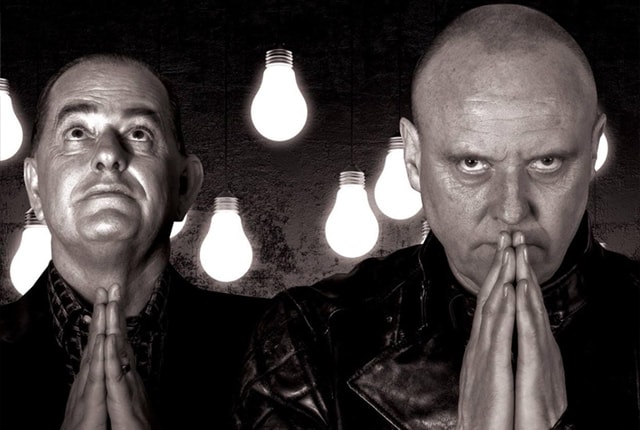
Over the past three decades, Theodor Bastard have developed a distinctive sound that draws on electronic music, folk traditions, and influences from around the world. Founded in St. Petersburg, Russia, in 1995 by musician and producer Fedor Svolotch, the project began with experimental electronics before evolving into a full band known for its atmospheric compositions, unusual instrumentation, and the otherworldly vocals of Yana Veva. Throughout their history, Theodor Bastard have continued to explore different musical approaches while maintaining a recognizable identity.
Their new album,▽ (out 11/13/2026), places a renewed emphasis on electronic instruments, which played a major role in the band’s early sound. Following 2020’s Volch’ya Yagoda, which drew inspiration from nature and traditional music, the new material has a more urban, unsettled atmosphere. The album responds to a changing world, exploring themes of uncertainty, conflict, and the relationship between humanity and technology. For Svolotch, making ▽ involved reconsidering familiar creative approaches and exploring new possibilities without feeling constrained by the band’s history.
In an email interview, Fedor Svolotch discussed the making of ▽, his evolving approach to electronic music, the role of language in Theodor Bastard’s songs, and how the group’s creative process has changed over the years.
▽ places a stronger emphasis on electronic sounds and rhythms. What led you to explore that side of the band’s sound more extensively on this album? How has your approach to electronic instruments and production evolved over the years?
Around the time of the pandemic, Yana and I started feeling a kind of burnout, to be honest. It was as if we had already learned to do everything we’d been doing pretty well, and we were tired of endless touring and of sound itself. And of fans constantly waiting for the next record, as if we were some kind of assembly line. I understand that people, especially our fans in Russia but also around the world, really love an album like Oikoumene. On that record we sing in many different languages. We used an approach that was pretty new for us at the time: basically, we replaced electronic sounds with live ethnic instruments, but approached them electronically! People really latched onto that album. I agree that in some ways it’s original. Though if I were making it now, I might do everything differently. But here’s the point: the hardest thing is inventing something like that in the first place. Doing it a second time isn’t all that interesting creatively.
And that was the background, this sort of barren ground where the new album began to grow. We didn’t want to repeat ourselves, but coming up with something new was very difficult. Actually, we started out with electronics. Back in the early 2000s I had my old Korg ESX sampler, a Soviet synthesizer called the Polivoks, which is fashionable now, although back in Soviet times you could find one gathering dust on a shelf in almost any community arts center. There was another Soviet synth called Yunost. That was the equipment we started with, and we made our first albums in a pretty experimental way. So electronic music was never alien to me. I loved all kinds of avant-garde groups, from Nurse With Wound and Einstürzende Neubauten to Autechre, Pan Sonic, Radian, and so on. But after so many years spent working with ethnic music, I’d naturally lost my feel for that kind of radical electronic sound. And on our previous albums I’d been using quite a lot of different software tools. Anyway, I’m giving you the background again.
Then came the pandemic. I’d built my own house deep in the forest, on the Karelian Isthmus, far from people. And while the cities were all in lockdown, my family and I moved out there. We ran into wild bears and foxes. And I thought I was done with music for good. We’d only just signed with Season of Mist, and our album had come out. Normally, when a band signs with a major label, you’re supposed to go on tour and do all those things. And we had great prospects; we’d been touring every year. Instead, there was the pandemic, and our manager died. Then the war began. So, yeah, I really thought I was finished with music and would spend the rest of my life living in the woods.
But it’s a good thing we live in modern times and there’s internet in the forest. At some point I started watching different things on YouTube, and I kept coming across videos about analog synthesizers. All these modern little things I call “electronic critters.” And I really wanted to buy some of them. I got my appetite for that kind of music back. I started listening to lots of different artists, lots of contemporary music. Although Yana and I had gone through a period when we hardly listened to anything at all. We felt we were just tired of sound. But apparently that time in the woods, the pandemic, the forced break, gave our music some new energy.
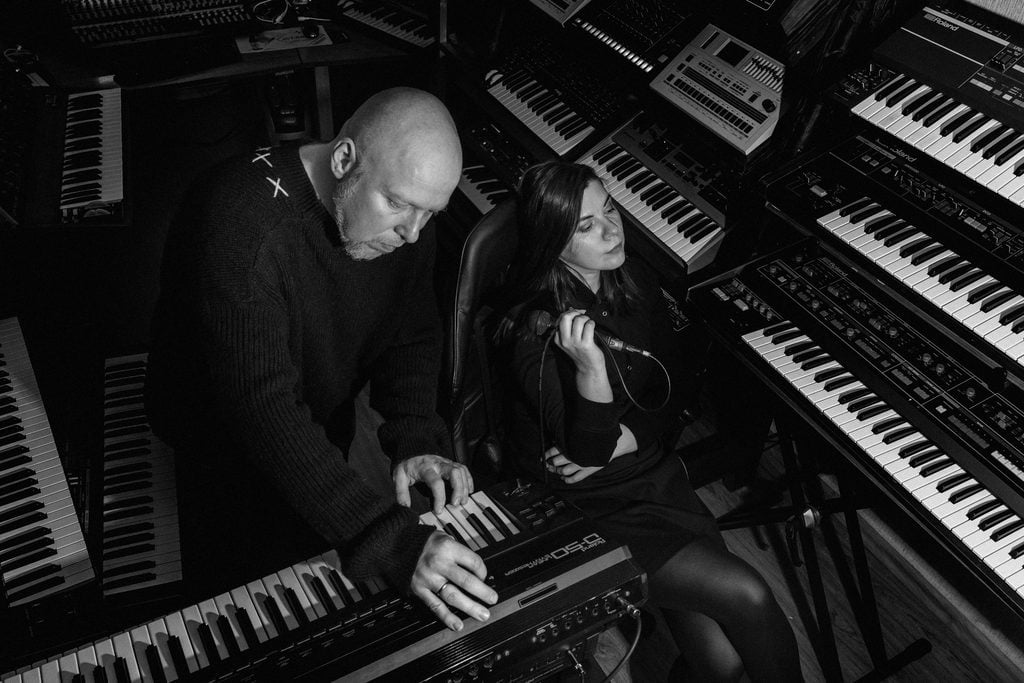
We gradually started putting together a collection of electronic devices: Arturia synths, the analog MiniBrute and the incredibly creative MicroFreak, and a Waldorf Blofeld. I repaired and brought my old Korg ESX sampler back to life. Pulled my dusty Kaoss Pad off the shelf. Bought a few of those little boutique synths from Korg, things like the Korg Volca. Got an Elektron sampler, an Elektron Model. And so on and so on. I ended up with a small setup that was really fun to experiment with. And unexpectedly, Yana got interested in it too. And suddenly we realized that the outlines of our next album were beginning to take shape. Somewhere at the intersection of the music we love and have always loved, all that IDM, noise, and clicks & cuts, but with a different kind of experience behind it now. Not like the experiments we did when we were young. We wanted to put all of it into some kind of form, to give certain sounds a different shape.
You’ve said that you wanted to approach ▽ as though Theodor Bastard had no past. What did that mean in practical terms when you were writing and recording the music?
From a commercial point of view, my late manager, who sadly didn’t survive COVID, was a really good person, a really good guy. But as the band’s manager, he had to think in marketing terms. He’d say, “Let’s make something like that again. People want something like that.” And I tried to explain that it would be too easy. Too easy for Yana and me. Back then we had to go through a long journey and years of experiments to make something like Oikoumene. Now I could probably record an album like that in a few months. Because we’d found the method. We knew the instruments. But back then, to make it, we had to go very deep into studying the music and the instruments. Over many years we built up a collection of more than seven hundred instruments, which are now in our studio. Everything from the Iranian daf, Turkish bağlam, Mongolian morin khuur, Scandinavian talharpa and jouhikko to Russian gusli and jaw harps. There are Chinese instruments in our collection. Japanese ones too. And traditional American instruments, including one of my favorites, by the way, the Appalachian dulcimer.
And I had to learn an enormous amount: what those instruments sound like, how they’re recorded, what traditions they come from. Of course, I can’t play all of them professionally. But at least I came to understand how they work, how they produce sound. Then I went to study darbuka with my Lebanese teacher, Osama Shahin, and that gave me a tremendous amount as a musician. I began to understand how these rhythms work. How a traditional Lebanese musician, a fifth-generation musician who plays the Arabic darbuka, thinks. That whole way of thinking, and how different it is from a European one. Meanwhile our percussionist went to Africa. He studied African rhythms and visited Namibia, Morocco, Ethiopia, and Tanzania, among other places. And Yana lived in China for a while, and came back with her beloved bawu flute and a love for Chinese music. It was a really intense period, full of experience, love for ethnic music, and an attempt to experiment, to make some kind of synthesis. And later, when we turned our attention north, we started studying that part of our own homeland, and the ancestors who lived there. We went on ethnographic expeditions to the Far North, too. It was fascinating.
Sorry, I’ve gone off on a tangent, but it’s a good example of how we approach albums. And making something like that one more time was, well, simply not interesting. Although, again, from a marketing point of view it might have been the right move.
And of course we knew that the audience who loved us as a kind of ethnic or folk band might be disappointed. Commercially speaking, it was probably a complete disaster of an idea. But we couldn’t stop, because when inspiration comes back after years of being completely indifferent to music, you have to take care of it.
Did you begin with particular themes in mind, or did those ideas emerge as the music developed?
Well, there was another reason this album came into being. The times we’re living in. Everything from the pandemic and the war and all the rest of it to artificial intelligence. This technological age, and all the things about it that make you angry and disappointed. We have a lot of dark feelings, including disappointment in people. It called for some kind of new language. Because however hard we try to be escapists, to live at the edge of the forest and play some kind of ethnic music, we’re still people. We have social media. All these events still pass through us. Although we try, as I call it, not to “vibrate” along with everybody else, following whatever wave is fashionable, putting little flags on our profile pictures, siding with the right one day and the left the next, and so on. Not to give in to the waves that shape public opinion artificially, whether it’s algorithms or various organized campaigns. Still, there are things about this era that inevitably get to us. How could they not? And those things came out in this album, which the guys at the label described very well as “dark music for dark times.” I think that’s probably a very good description. Some kind of inner concept we had from the beginning without even realizing it. Anyway, we threw ourselves into it headfirst. And what came out is, for us, one of the hardest-won, most important and most conceptual works Theodor Bastard have made.

Do you tend to build arrangements through experimentation in the studio, or do you usually have a fairly clear idea of how a piece should sound before recording begins?
As for arrangements, I think my approach has always been fairly close to that of a lot of other electronic musicians. Brian Eno put it very well once, I think: the studio as a musical instrument. And I don’t really feel like a musician. Even though over the years I’ve learned to play a lot of instruments, from guitar, ukulele, bass guitar, drums, and ethnic percussion to all kinds of flutes and other things. But all my life I’ve felt more like an architect of sound. Same with Yana. Because she’s a full partner in the process of making our songs. She’s not just a singer. She plays keyboards and a lot of other instruments. She has a flawless ear for timbre. Her taste is very close to mine. But I don’t think either of us would call ourselves musicians. We’re architects and builders of sound. On one hand, that’s a huge advantage for us. On the other hand, it’s a curse.
Because it means hours, what am I saying, years spent in the studio. This damn perfectionism. Hundreds of tracks, sometimes up to 500. Going through samples. You can spend hours choosing a single kick drum. Then replace it with something else a week later. Then you’re hunting for the right bass sound. That’s how it goes. And the worst part of the curse is that you then have to play all this live. With an actual band. And that’s another whole job of the same size. Because you have to adapt it for the stage. I’ve even written about this in several articles. I sometimes write articles about music for my blog, and I’ve written about how difficult it is to adapt an originally electronic album for a large live ensemble. In terms of work, it’s almost like making another album.
How do we write? Sometimes a piece starts with an electronic improvisation. Sometimes it starts with something Yana has come up with, with her singing. Or I might play something on a guitar or sing something myself, but that’s rarer. Quite often I just find or dial in a sound I really like, like the sound I made on the Arturia MiniBrute for the song “Nebo.” I loved it. I recorded it right away. And the MiniBrute is a completely analog synth, so you can’t save a preset on it. Unless you make one of those little cardboard templates and mark where the knobs were. So I documented it that way. I played it through several times, recording a few complete takes live to a metronome. And then we built an entire song around it. That’s roughly how we work.
But like I said, that means hours of doubt, moving files and loops back and forth. Sometimes I think I miss live music. In our new show, the concerts where we’re presenting the album, I’m playing bass. I actually started out on bass back in the ’90s. I played in a few bands doing instrumental music that people would probably call post-rock now. Something like that. And I’m enjoying getting back into the instrument so much that sometimes I think I miss making music without computers. Live improvisation. All those human things, mistakes included, without everything locked to some digital grid. But that’s a whole other, very long conversation, to be honest.
The album’s title is simply the symbol ▽. What does it represent to you? Did you have any concerns about the practical implications of using a symbol as a title, such as how people would search for the album online or discuss it?
The album title, yes, it’s a symbol. It somehow came to us. On the one hand, some people read it as an arrow pointing down. On the other hand, I see it as a kind of sign of expansion. From one to many. Because at some point I began to feel that humanity would destroy the planet. And somehow we all need to start thinking about colonizing other planets, finding somewhere else to live, if humanity still has a chance. And at the same time, these thoughts bring me to the idea of panspermia. To the question of who we are, where we came from as human beings, as a species. And now we’ve created artificial intelligence, which may turn out to be another, the next form of life that spreads through space, something science-fiction writers were writing about long ago. It’s entirely possible that’s what will happen. And what if we ourselves are just another species biologically engineered by some creator?
So those thoughts gave rise to this sign, this particular symbol. Some people might see it as a descent. For me, it’s from one to many, from one Earth out into space, expansion. Anyway, that’s the feeling behind it. And of course everyone tried to talk me out of using a symbol like that, management and everybody else. The label also ran into problems figuring out how to enter that character into all the catalogs and digital systems. How would people find the album? But that didn’t put Yana and me off. We think it’s a really beautiful gesture. Because we deliberately made a pretty uncommercial album. We went our own way with it. So we gave it a title that’s just as hard to read as our music.
There’s a considerable range of moods across ▽. How did you approach arranging the tracks into a cohesive album?
For us, the order of songs has always been extremely important, both on an album and in a live set. I think of the songs almost as scenes in a play. The way they follow one another determines how the story unfolds. Sometimes moving just two songs around can change the meaning of the whole thing.
When we first started writing this album, we already knew that “Vremya” (“Time”) had to be the last track. Because that’s where the entire story comes to an end.
There’s a line in the song: “Time stands still, and that’s it.” And right after those words, the music suddenly cuts off. Then there’s a modulation up a whole step, an organ comes in, and this completely different, psychedelic music begins. Something that reminds me of the 1960s. It’s as if the whole technological nightmare we’ve just been through never existed. The music gradually fades into the distance, and all that’s left is the wind and birds singing.
There’s actually a little story behind those birds. This summer, while I was finishing the album, I was walking by a lake not far from my house, listening to “Vremya” on my headphones. The song ended, and suddenly I heard real birds singing through my headphones. They sounded as though they were continuing the music! I immediately grabbed my recorder and recorded them. And then I thought: That’s it. That’s how the album should end.
It was as if everything had been reset. Maybe human civilization no longer exists at that point, at least within the story of the album. Maybe it’s all over. But nature is still there. The birds are singing. The wind is blowing. There’s something about that which feels like a return to the original beauty of the world.
And it’s very important to me that these are the actual birds I heard at that exact moment, when the song ended. I couldn’t have planned it. No sample library could have given me that experience.
At the other end of the album, we begin with a poem that I wrote, performed by our friend, the hip-hop singer Gale Dorothy. It’s about all of us being trapped at the bottom of a very deep pit. Actually, the idea of falling appears throughout the album in different forms.
That’s why the sequence of the other songs matters so much.
For example, I knew that “Kaplya Rosi” (“Drop of Dew”) had to be followed by “Zveroboy,” which is almost infernal in its meaning. Then comes “Dusha” (“Soul”), a deeply repentant song that feels almost like something from the afterlife. And after that, “Ditya” (“Child”), which is completely cosmic and psychedelic.
“Ditya” is probably one of the strangest songs on the album in terms of meaning. It’s about a mother, but several different mothers at once. There’s a real human mother, Mother Earth, a mother spaceship, and an artificial intelligence called M.A.T.Ь. (“Mother”).
A child is connected to its mother. An astronaut is connected to the mother ship by an oxygen hose, almost like an umbilical cord. And today, human beings are becoming increasingly connected to AI. All these images exist together, tangled up in one surreal story. Sometimes it’s hard to tell where one ends and another begins.
Then there’s “Ostavlyaem,” about leaving Earth. And “Sverkay,” which, to me, is almost about a Promethean sacrifice, with the words “Shine, burn, and disappear.”
And finally, “Vremya,” where there will be no more time. There’s something almost biblical about that idea. And after all these nightmares, machines, and strange visions, what remains? Nature. Birds. Wind.
Recently, we held a private listening session for a small group of fans. And someone said something I thought was very accurate: the album sounds almost like a musical. Not literally, of course. They meant the way the songs work together as one larger piece, with a story running through them. I agree with that.
I think the album turned out so cohesive because Yana and I weren’t thinking about individual songs when we were writing it. We were thinking about the whole thing, the larger form, and how one piece would lead into the next.
But I certainly don’t want to insist that everyone hears the same story. People will probably find entirely different meanings in these songs, things we never even thought of. And that’s perfectly fine with me. In fact, I like that possibility.
Theodor Bastard’s music has evolved quite a bit over the years. To what extent have those changes reflected your own evolving musical interests, and how much have they been influenced by the different musicians you’ve worked with?
The changes in our music, as I described earlier, reflect our lives as people first of all. I guess it’s that way for every musician. Of course, Yana and I have written a lot of music for film and video games in recent years. That definitely gave us new experience. Broadened our horizons. Made us look at sound in a different way. I can say without exaggeration that we spend ten to twelve hours a day working with music and sound, every single day, and have been doing that for years. Sometimes it starts to feel like Groundhog Day. But that’s our life. And when you live like that, sooner or later all that work turns into something. It gets carried over into something else.
What role does language play in your music, and given your international audience, how important is it that listeners understand the words?
Language… On the one hand, we’ve always seen singing as another instrument. I mean, for example, there’s a violin, or some lead synth, and then there’s the voice. And Yana and I have always disliked publishing lyrics separately, because to us that’s like publishing one instrumental part separately from the whole piece. For us, the lyrics and the singing, the sound of the voice, were just one more voice within the whole palette of our music. But at the same time, Yana is deeply interested in poetry. She’s grown enormously as a poet. On the early albums, back around 2004, I wrote most of the lyrics. Now I can say that Yana writes most of them. And sometimes she comes up with really powerful images. I don’t know how much of that can even be carried over in translation, to give you an example. But to me it’s real poetry, quite powerful poetry, including on this new album… Most of the lyrics are Yana’s. There are a couple of songs I wrote lyrics for, but mostly it’s Yana. And the words mean a great deal to her. They give the music another dimension. Another thing to say.
But our approach to lyrics hasn’t really changed much over the years. We still love metaphorical texts, what we call “abstract lyrics.” We also experimented with automatic writing at one point. We like images that are as tangled, many-sided, and layered as possible. We don’t like saying things straight out. We like what people call the language of poetry. And that album Oikoumene I mentioned earlier, for example, the songs there are mostly in invented languages. There’s no Russian on it at all. And I’m just as close to that album. Even when the songs are in what you’d call glossolalia, they still tell me certain stories. Even though I don’t understand the words. You feel that too, right?
That’s the miracle of the language of music. We are divided as people, not only by cultural differences, but above all by language. And yet most of us feel and understand music in much the same way. Music is a universal language of human communication, especially when it comes to conveying feelings and abstract ideas that are sometimes very hard to express in ordinary words.
You’ve composed music for video games, films and television. Does working on soundtracks give you opportunities to experiment with ideas that might not otherwise find their way into Theodor Bastard’s music?
As for soundtracks, absolutely, that work has given us a lot. Although at first we saw it as work we didn’t especially love, but needed to do. Just to survive. Just to have something to feed ourselves and our families. When you work for someone else, it’s a strange feeling if you’ve spent your whole life being responsible only for your own work and doing whatever you wanted. When you’re working on commission, there’s a client. There are requirements. There’s criticism. There are revisions. And quite often it’s really irritating. But on the other hand, it disciplines you. And sometimes you get assignments you would never have taken on in your life. For me, for instance, writing a choral arrangement was something almost unbelievable. Or writing some orchestral parts. Things we’d never tried and probably wouldn’t have tried on our own. But you take them on and do them because someone’s paying you. And then, after a year or two of that work, you suddenly realize you’ve gained a very particular kind of experience. And you start using it in your own music, sometimes without even being aware of it. Because things that used to scare the shit out of you don’t scare you anymore. You’ve done them. Over the last couple of years, for example, we’ve written more than eighty different pieces of music for films and video games. Of course that kind of experience gives you a lot.
But there have also been games like Pathologic 2, where, first of all, the creators gave us complete freedom. And second, we were working almost entirely out of enthusiasm. For us, it was mainly a creative encounter with the game’s incredibly powerful artistic world. Like a collaboration between two completely different art forms, a kind of convergence. That was a really cool experience too. It wasn’t commercial, but it still brings us new fans and listeners. People come up to us and say, “I played that game and now I’m your fan!” And they’re waiting for our music in the next installments of the game. Isn’t that amazing?
After more than 30 years of making music as Theodor Bastard, what continues to excite you about the creative process? Are there still musical directions or approaches that you’re particularly interested in exploring?
Listen, that number scares me. More than thirty years. Honestly, since we came out of that hole of depression and burnout after the pandemic, like I was telling you about, I feel as though my life as a musician has only just begun. Like I’m only just starting to understand certain things. I’ve started studying harmony seriously. I’ve started figuring out things about groove, what groove actually is. I want to learn to play a lot of other instruments now. For example, I’m a pretty mediocre piano player. I want to learn that properly too. I’ve become interested in jazz. Even though I despised that music my whole life. Now I understand it. I can follow what’s going on, all those shifting meters, beats, melodies, complicated scale degrees. Different ways of thinking harmonically have started to make sense to me. And through that, a huge part of classical music has opened up to me. Before that, the only classical music I had any respect for was the avant-garde, Schnittke, Stockhausen, and so on!
For the first time, I’m starting to feel like I can really do something on the bass, beyond the amateur level, at some deeper level. I’ve become genuinely obsessed with audio engineering. I recorded and mixed this album myself. Yana and I now have our own studio with our own instruments. Yana is constantly learning things too. Just listen to her singing. After the three singles from the new album came out, I read comments from fans asking, “Where’s that ethnic singing Yana is famous for? Why is she singing so calmly here?”
But people don’t understand that for an ethnic-style singer who can easily sing in that Lisa Gerrard kind of way, singing like this, with a modern breathy, subtone technique, presenting the voice this way, not hiding behind huge reverb, not hiding behind a loud, forceful chest voice, which is difficult for many singers… For Yana, that powerful ethnic-style singing, all those melismas and that extremely wide range, that’s easy. But singing with clearly articulated words, singing in a very dry space, without being smeared all over with reverb, singing in a completely different way, using subtone and modern vocal techniques… Or take the way she even uses a kind of vocal distortion on “Vedma.” That’s a real challenge for her. It shows what level she’s at as a vocalist, what she’s capable of. Just listen to Oikoumene, then Pustota, and then this album. It’s like three different people singing. And it’s all one singer.
That’s why I’ve worked with Yana for so many years. Of course she’s a creative and interesting person, but above all her voice drives me crazy with what it can do. I know a huge number of musicians, and I’ve never met anyone who can sing with that much flexibility, in that many different ways. She’s a truly powerful professional. I think she’s not well known enough as a singer simply because she’s modest, doesn’t maintain social media accounts, doesn’t promote herself anywhere, and because we as a band don’t do much large-scale promotion either. Completely undeserved. Because her voice is really a diamond on the world stage. I’m certain of that.
So we’re interested in everything in music right now. I don’t know if one lifetime will be enough. But you have to keep learning, and sometimes I regret it, I kick myself for not studying more when I was younger, for thinking at times that I understood everything and all the roads were already open. No. Music is endless. And above all, of course, there’s a spiritual path in it, a way to develop yourself. That’s where I see a path, that’s where I see depth. And from what Yana has told me, she feels the same way.
Thank you for the interesting questions.
You can purchase ▽ from theodorbastard.bandcamp.com. For more info, visit theodorbastard.com.