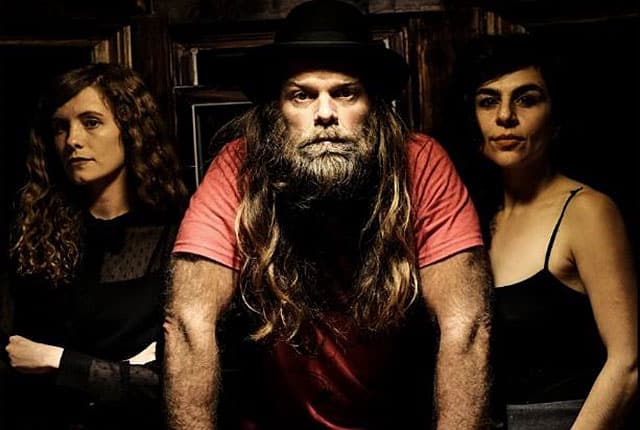
Thirty years after its original release, Reseda Spleen, the 1996 debut album from Los Angeles psychedelic rock project Ventilator, is getting a new lease on life through a reissue from Bar/None Records. Led by singer, songwriter, and guitarist Matt Devine, Ventilator emerged following his departure from Permanent Green Light, the power-pop band he shared with former Three O’Clock frontman Michael Quercio.
Recorded largely in Devine’s North Hollywood apartment using a Tascam 388 eight-track tape recorder, Reseda Spleen blends melodic songwriting with noisy guitars, atmospheric textures, and moments of experimentation. While Devine was the driving creative force behind the project, the album also features contributions from drummer Byron Reynolds (Possum Dixon), lap steel guitarist Jeff Caruana, and Brad Laner of Medicine, who played bass on “Earthquake Song” and mixed “Schadenfreude.” The majority of the album was mixed by Earle Mankey, whose extensive credits include Sparks, the Runaways, and the Beach Boys.
In the following interview, Devine looks back on the making of Reseda Spleen, from the creative freedom of working on his own terms to the challenges of recording with limited equipment. He also discusses how the reissue came together, his changing approach to songwriting, and the possibility of performing the material live again.
How did this reissue come about? Was it something you’d been pursuing, or did a label approach you?
Matt Devine: Yeah, it’s funny. It was interesting because I knew 30 years was approaching since the record came out, and that was last year. And I was like, “Oh yeah, that record came out and how would it happen that it gets reissued?” And I talked to a friend of mine, his name’s John Strohm. He’s a lawyer and a musician. He was in the Lemonheads and Blake Babies. Just a great guy, and I’ve known him for a while. And I said, “Hey, John, the record, it’s been 30 years.” And he said, “I want to help you.” I went, “Oh, great, that’s awesome.” I didn’t know what that would look like yet, but he said he was up for doing what it is he could to get interest. The summer happened, and then out of the blue, Glenn Morrow called me.
And we hadn’t talked in years. We caught up a little, and he brought up the record and talked about that he’d been listening to it recently and how he always loved it. The conversation on that was, I said, “It’s too bad you didn’t release it back then,” because he had heard it back then and was interested in maybe picking it up from the label that had released it, and that didn’t happen. And he said, “Yeah, well, maybe I’ll do it now.” And I said, “That sounds great.” And that’s how it happened. It was all very organic, how it came together.
It contains two additional tracks, is that correct?
Matt Devine: On streaming. So they wanted extra tracks for streaming. There were more than a few, and I selected those. “Titanic” was in the running [for the main album]. It’s an instrumental though, so having an instrumental on a record, it’s a thing, and so it got omitted. And then the other song is a cover of a Loudon Wainwright song called “Winter Song,” and that was one of the first recordings I made after I got the Tascam 388 machine where I was kind of experimenting with, “Okay, I’m recording, I’m going to do an acoustic guitar,” and I got this great sound on it where I had a pickup in the acoustic and I plugged it into the Marshall. So at the same time that you’re hearing the acoustic, it’s this big fuzzy Marshall sound that’s going along to it, and I liked it a lot. And it’s a cover, so having two covers on the record, because we wound up using the Skip Spence cover that’s on it, “Little Hands,” and so that’s why they were outtakes. And I’ve always liked the recordings and they seemed like a good choice.
Having come from a band background, did doing things yourself allow you to try things you hadn’t had the opportunity to do in the past? What were your goals going into making “Reseda Spleen”?
Matt Devine: Yeah, it was definitely different. And I think that’s a lot of what made Reseda Spleen Reseda Spleen, was me being left to my own devices. And I moved at my own pace, and I worked in an environment that I had created, to be creative in, in the apartment, having my space to write songs and my space to record, and leaving behind the idea of hanging out at nightclubs and being on the scene and networking, and you get a band together and then you learn songs and okay, “We better demo them.” And once you demo them, then we have to find a “real studio.” And I just left that all behind. I’m like, “You know what? I just want to write and record and get straight to the fun stuff and not worry about all that social stuff, being in a loud bar where people are talking,” and I really pulled away. And I think for me, that’s how I got a record like I did, was just investing time in myself and moving at my own speed.
Given that process, was there a challenge at all in terms of knowing when something was done?
Matt Devine: Oh, absolutely. I think less so than when I think of doing that now and having all the time in the world, things never get done. But I was pretty hell-bent and really wanted to get my songs recorded and out there, but I did move at my own pace and there are pros and cons with that. There’s a lot of pros speaking to Reseda Spleen because I got the music that I did and I’m happy I did it, but things take longer and maybe other people aren’t invested as much. If you have a whole band and you’re going that route, then there’s more expectations like how are you tracking, what deadlines are you hitting? And there was really no deadline. And I think that might be part of the Ventilator sound is just spending as much time as I want. And then conversely, maybe moving faster where I like this and there’s no other folks that need to weigh in on it, or this is kind of raw, but I like it that way. And so it definitely was a big part of it, just operating at Ventilator time.
Do you ever think about how you would approach an album like this now with the current recording technology? Do you feel that working on the Tascam multitrack added to the overall character of the album?
Matt Devine: I think absolutely the Tascam 388 was a big part of it. It’s eight tracks. So only having eight tracks to work with, it creates a limitation where you have to get your point across with what you have. And nowadays with digital recording, the sky’s the limit. You can have 128 tracks if you want. And that creates a different problem where you can just do anything and everything. And I’ve done that too over the years. I moved on and started recording on Logic on a Mac. It creates a different situation where, “Oh, I can do it a different way. I can change this guitar sound to be that.” But once you record onto tape and you hear it back and it’s like, “Well, that’s it,” you can bounce and you can do treatments, but then you’re getting a certain level of degradation with the fidelity.
And then the last thing I’ll say is working in a linear fashion where you hit play and the tape starts moving and you have to wait for your spot to hop in rather than being digital where you can loop it and try it as many times as you want till you get your take. And so I got pretty good at playing the guitar and tapping on the punch in with my toe to get it to go record and then playing along and getting in there. I had a little pedal that I would stomp on to punch in. And so it takes a lot of time and it is a lot of work to do it that way, but there’s something to be said for it.
Could you talk about how the material evolved as you recorded the album? What were some of the first songs you worked on, and how did the sound develop from there?
Matt Devine: With Reseda Spleen, I think, like I said, I had done “Winter Song” early. Really the first song that manifested itself into something that I wanted to pursue as a recording, there’s a song on the second side called “Lint Duet,” and it’s acoustic and there are two acoustics left and right. And that was really the first recording where I heard things back and I liked it and I embraced the way that things were sounding. I had gotten this compressor, very inexpensive compressor. It was a Russian compressor that I got through an ad in the back of a magazine. And so being able to get a compressor for 200 or 300 bucks was like, “Oh wow, I got this.” And so I put the acoustic through it and recorded it to tape. And you can hear in the recording there’s cars passing by in front of the house going up and down Colfax, and I hear that and I hear the sounds of the neighborhood in the apartment.
So really it takes me back listening to it now, but at the time I just embraced, this is where I’m recording. I’m in an apartment, this is my compressor, this is my guitar, this is how it’s sounding. And I just started to move from there. And Byron coming on board, he was such a great drummer, he overdubbed on a song, “Lansdowne,” and I was like, “This sounds great. We should get you in a place where you can be loud.” So we moved everything. We lugged the eight-track, all my mics and cables and speaker to monitor through to a friend’s house in Pomona, and we were able to turn it up. And so then all that rock and roll started to kick in with it and made Reseda Spleen sound like Reseda Spleen. As far as a further evolution, that would be the recordings that make up the second Ventilator record where I was really pushing the machine and varispeeding and bouncing and treating guitars, but that’s a whole other conversation.
When you were making this album, did you see it primarily as a studio project? Were you thinking about how this music would be performed live? Were you planning on touring extensively?
Matt Devine: That’s a good question. And I would say in some ways, definitely no, because there’s a lot of acoustic songs on the record. There’s a song that doesn’t have any drums. It’s the last song, which is six minutes long, where I’m just playing guitar and there are lap steels. And I didn’t worry about, “Hey guys, will you be available next year to tour?” It really was just being creative and enjoying what was happening. Once the record got out there, there was a degree of interest around LA, a couple record labels, nothing extensive, but people would start asking, “When are you playing live?” And “why are you recording at home? Shouldn’t you be in a real studio?” And some of those questions came from me in my head like, “Am I on track here with what I’m doing?” But the dynamic did change after Reseda Spleen came out as far as expectations with myself and with other people and that. But Reseda Spleen, as it was, was really all about just doing the music that wound up there and not really worrying about where it goes.
There were clearly a lot of positives to recording at home, but were there any limitations you struggled with at the time?
Matt Devine: Let me think about that. I think that not having a band in a traditional sense, because definitely it felt like a band thing because Byron brought so much of his character and skill to it. And Jeff, the lap steel player, was a big sounding board where he would hear the songs before they came together and before recordings happened or listening to mixes and things. So it definitely had a band vibe. But as far as the limitation of getting people who are committed and in the same room with guitars and we’re playing Friday night, we’re going to be having a show next month, that creates a different dynamic where things can move faster, I think.
Byron, towards the second half of making the record, he had rejoined Possum Dixon and started touring with them. So he wasn’t at the ready to do more recordings. So he would come back into town. I’m like, “Hey, you’re back in town. I want to take photos because this is actually coming together and going to be a record.” So we were able to grab photos of him, and he was on board for future Ventilator songs. But what I’m saying is maybe if Byron was in town the whole time, maybe all 11 songs would have drums on them. But instead there’s acoustic things. And so I embraced the idea of just being creative and getting songs across, but it’s like the eight tracks, right? You can’t have that ninth track, so you make do. And I think that’s what I did there.
With the reissue and listening to the album again, did you find that you’ve drawn any inspiration again from this material that might have an impact on what you do in the future?
Matt Devine: Wow, that’s a great question. I have to think about that. I would listen to the record over the years. I’d think of a song and I’d go and listen to the song again because it takes me back to that period of time. I just moved in with Linda, who was my girlfriend. We’re married and have been together for years. And so I listened to it and it reminds me of that time of moving in together. And we had this awesome dog, Alex, that was just terrific, and it just was a great time in our lives. And so listening to the record brings me back to that. And I never stopped songwriting and playing guitar, just the level of ambition changed as years went on. And so listening to it, getting to that spot of coming up with lyrics that communicate something, I think it was different back then for me because I was operating more instinctively, while now I might be more critical of myself. And, “What am I singing about here?” I was just kind of moving at a certain clip that a guy who’s 25 was moving at, and now the way I approach things is different. So I don’t know if that directly answered your question, but it’s definitely different now.
I was thinking about Paul Simon. I remember a really interesting interview where he talked about writing and he said that, “I’m probably a better songwriter now, but it takes way more to write a song.” Because back when he was doing all that stuff in the ’60s, which is insane how many amazing songs he had and classics, he was just doing it. And then now the way he approaches things is just, you would think it would, logically speaking, it would be way more of all these amazing songs, but it’s actually apparently challenging for him in a different way. I thought that was an interesting way that he saw himself in his creativity.
So is there anything coming up in relation to the reissue? Are you doing any live shows or anything you’d like to mention?
Matt Devine: Yeah, we’re not opposed. We’ve been getting together and hanging out and rehearsing and maybe more reminiscing and kind of enjoying each other’s company. We’ve always stayed in touch and would hang out over the years, but we’ve just been more active getting together. So there’s no plans with playing live because that in and of itself is a whole thing, getting that together and where would it be and all the planning. So it’s more just enjoying the reissue and each other’s company. And if someone approaches us with something that feels right, then we would be up for it.
Purchase Reseda Spleen at ventilatorofficial.bandcamp.com