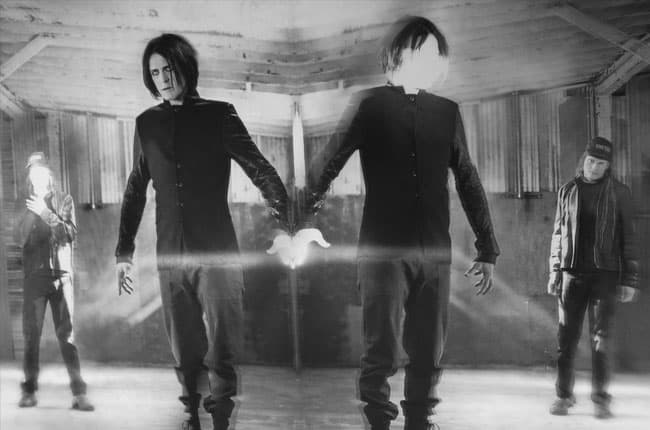
For more than a decade, hackedepicciotto have embraced movement as both a way of life and a creative philosophy. Danielle de Picciotto and Alexander Hacke have recorded albums everywhere from a medieval church in Austria to Blackpool on England’s northwest coast and a historic studio in Naples, allowing each location to shape the character of the music. Their latest release, LICHTUNG, marks a significant departure: after 14 years of nomadic living, the duo have settled on the outskirts of Berlin, creating their first album from a place they can finally call home.
That newfound stability has opened new creative possibilities. Working from a permanent studio where they once again have access to the full range of instruments they’ve accumulated over the years, the pair expanded their sonic palette, placing a greater emphasis on electronics alongside piano, hurdy-gurdy, violin, bass, percussion, and the cinematic atmospheres that have long defined their work. The album also represents a personal full circle for Hacke, returning to the neighbourhood where his fascination with electronic music first began before joining Einstürzende Neubauten, while for de Picciotto it meant writing and singing entirely in German for the first time.
The result is an album that reflects both sanctuary and uncertainty. Named after the German word for a forest clearing where light breaks through the trees, LICHTUNG finds hackedepicciotto exploring themes of home, transformation, and finding moments of calm amid an increasingly turbulent world. Long-form compositions, richly textured electronics, and lyrics that connect intimate experience with wider social realities make it one of the duo’s most distinctive and deeply personal works to date.
In this interview, hackedepicciotto discuss settling after years on the road, writing and singing entirely in German, reconnecting with electronic music, and the ideas behind LICHTUNG.
Your previous albums have often been influenced by place. Being close to where Alexander grew up now, how did it impact this one?
Alexander Hacke: Well, the previous albums were recorded in places like the Mojave Desert, in Blackpool on the northwest coast of England, in a medieval church, and stuff. And now, for a change, we recorded it in Berlin, on the outskirts of Berlin, in a place called Lichtenrade, which is very close to the border of Brandenburg, the next state over. And it’s home.
Danielle de Picciotto: We’re in the area where Alexander grew up, basically, which I didn’t know originally when we decided to move to this house. And the house was a magical happening. We didn’t expect it to happen. Somebody who really likes us offered us the chance to move in here, so we looked at it and said it’s perfect. It’s got a lot of space for studios and things like that, because we just couldn’t make up our minds where to settle down. So crazily enough, we settled down exactly where Alex grew up. He knows every stick and stone of the whole area, and he can tell me stories about every bus station and every street corner.
Alexander Hacke: There’s a maple tree at a bus stop around the corner. That’s where my grandfather, my father’s father, when he was in his 50s, way back in the ’50s, got drunk and decided to climb that tree to shake down the cones. What do you call it? Maple. Was it a maple? Anyway, to shake down these things, the little pine cones or whatever it was, for the kids. And as he was drunk, he slipped and fell and died. So I never met him.
Danielle de Picciotto: For me, it’s very different because I don’t know this area at all. I had never been here before, and I’ve also never lived on the outskirts of a city. I mean, I grew up in big places like New York or whatever. So for me, it’s a completely new world. We’re having very opposite experiences, which is interesting because it’s the first time, and that has basically influenced our album a lot.
Did it also perhaps influence it in the sense that being more permanent might allow for a larger home studio setup?
Alexander Hacke: Well, the building that we’re in was built in 1932, and for some reason they knew what was coming. So the building has, in its basement, a perfectly equipped bomb shelter, which now is our rehearsal space. It’s where all the drumming and loud amplification takes place. So that’s a very cool thing. We never had something like that before.
Danielle de Picciotto: I mean, we’ve always basically had the studio that we have now, which we took along with us, but we couldn’t take all the instruments with us that we collected over the years. So that definitely makes a difference, that we’re able to play more instruments and that we also kind of have the peace of mind to be able to do it for longer. I mean, if you rent a studio, you always have a short, limited amount of time where you can do it. Here, we can just do it all the time. We can work as much as we want. So that definitely makes a difference.
Are there any particular songs on the album that you feel were particularly affected by that aspect of it?
Alexander Hacke: Well, the opener and the title track, “Lichtung,” is definitely very much in tune with, or very much informed by, our surroundings. It’s supposed to sound like what it feels like to be here.
Danielle de Picciotto: Yeah. And we use all kinds of instruments that we haven’t necessarily used before. So it’s a perfect picture of where we’ve moved and the difference in how we can work here.
Could you talk about the album title and how it relates to everything that went along with making it?
Alexander Hacke: A Lichtung is a clearing, and this part of Berlin is Lichtenrade, and that comes from Lichtenrode, which means to cut a clearing into the forest. So that’s basically what this area is called. And also, a clearing is the place in a dark forest where the light comes in. Yeah.
Danielle de Picciotto: There’s basically the picture that we had come to an impasse in a way. We were nomads for 14 years, and it seemed that every time we wanted to move somewhere, something horrible politically would happen in that place. So we just couldn’t decide. And when this popped up, it was extremely unexpected, and we decided that it was like suddenly being in a clearing where you can see the sun a little bit.
I mean, we don’t know if this is going to last or how long it’s going to be, but it’s definitely our situation at the moment. And because we’ve been able to settle down and take all our boxes out of the storage room, it feels like we’re in this little space where we can breathe while the storms are raging outside. That’s one of the lyrics too, where we’re safe for the time being.
I’m curious about the aspect of writing and singing in German this time.
Danielle de Picciotto: Well, I’m American, so I still dream and think and write in English. It’s more natural for me. But I thought, okay, I’ve been living in Berlin since 1987. We were nomads for 14 years, and now we’ve decided to come back here.
Originally, I really, really wanted to go somewhere English-speaking because I really miss that. And I thought, okay, well, if I’m moving back here, then I should really kind of deal with the language and see… I don’t know how to put it, like facing the reality that I’ve been here for such a long time and this has been my home for the longest part of my life, in a way.
So I thought, well, it’s kind of strange if I’m living in a country and I’m speaking in a language that the people don’t speak and many people can’t understand. I mean, most people understand English, but still, it’s very different if you’re actually speaking the language of the country. I thought I kind of owe it to Germany to sing in German so that they can all understand me.
We’ve done a couple of shows with the new album now in Germany, and it really makes a difference. It’s surprising what a difference it makes. And it was a really interesting experiment because writing in a different language, one that’s not your mother tongue… I can speak German fluently, so it’s not that it’s difficult, but writing in German is completely different from writing in English because the German language has a very different way of people using it politically.
There are a lot of words you can’t use in German just any way you want because they speak of a certain era or a certain political idea, especially because of the whole Second World War thing. You have to be really careful how you use certain words. I’m not used to that because in English you don’t have it to such an extent. So it was really, really interesting because it taught me a lot about the country I’m living in all over again.
Considering that you have an international audience, do you think about lyrics differently at all in terms of how they may come across to somebody who doesn’t actually understand the words? In terms of the lyrics’ role within the overall composition?
Alexander Hacke: Well, I think the fact that we use the German language on this album is a bit of a nod towards this culture and this background. Also, as opposed to using English, which is all right—it’s the pilot’s language—but it also is very much connected to political developments in the world right now.
And I think by this we kind of impose, or we establish, a new sense of innocence for the listener to discover us or to experience what we’re doing, rather than getting an explanation in the language of the Americas within the content. It now opens up to interpretation, and also people who don’t speak German might be inspired to look at the lyrics and research the things that we’re talking about and stuff. That just opens up a whole new era of experience, I think.
Danielle de Picciotto: And I mean, we did sing in Latin for a long time. Our first albums were all in Latin. Nobody really understands Latin. So in a way we kind of did that back then, to have lyrics but not necessarily expect people to understand them. But we knew what we were saying. So it was kind of like a hidden symbolic thing that people could find out if they wanted to.
And I don’t know. I mean, it really does make a difference if you’re singing to an audience in their language. I always noticed that when we toured in the US or in England because people would just react differently, and that’s what was happening in Germany now, which is interesting.
And I mean, I felt a little guilty towards our international audience, but then again, we tour a lot in Italy and we don’t speak Italian. We tour a lot in the Scandinavian countries. So basically, the people who are interested can read the lyrics.
Interestingly, too, some people don’t even want to know what the lyrics are. We have a friend who refuses to even understand the lyrics, even if they’re in English, although he’s American. He’s like, “I don’t want to know what people are telling me. I just want to hear it as a musical thing.”
So there are all these different connections, and for me, because I’m really interested in languages, it was a really interesting experience. I think in future I’ll probably do a couple in German, a couple in English, a couple in Latin, whatever. I’m not going to only do one language, but to do one whole album in German was really interesting.
Alexander Hacke: We speak Denglisch. Sometimes we speak German for a while, but then if an emphasis has to be made, we switch to English.
Beyond what we were discussing regarding the studio itself, were there any major differences in terms of the creative approach musically on this album?
Danielle de Picciotto: Yeah. I mean, up to now we’ve basically done… pretty much, our music style for us was drone, which means that it’s very kind of repetitive, with long passages. And this time we were kind of interested, for one, in working with more electronics because we kind of wanted it to have more of a contemporary sound.
We somehow felt that, to mirror a contemporary feeling, you also kind of have to have a contemporary sound, and we really felt the urge. I mean, Alex has a lot of sound libraries with electronic sounds, and I just finished doing an album with Phew, a Japanese musician, that was purely electronic. All of my solo albums were electronic. So we both have a history of electronic music, and we thought the balance wasn’t really there with all the instruments that we play and the electronics. We wanted to work more on that.
Alexander Hacke: And also, for me, it’s like going full circle, coming back to this area where I attended grammar school and also where my musical experimentations began some 45 years ago with analog synthesizers and stuff like that. So it kind of was natural to hook up some of that old equipment again, or work with waveforms and envelope shapes and stuff like that rather than plucking a stringed instrument. So it was a natural kind of change in the approach.
Danielle de Picciotto: Also, I play piano, which I haven’t done since our album Hitman’s Heel, which was our very first album. That one was more ballad-oriented, and I felt that somehow I wanted to play piano again. We do a lot of film music, and I had been playing a lot of piano there. I suddenly thought, why am I actually not playing piano in our band?
In terms of the electronic aspect, given that there are so many possibilities, was it fairly obvious what equipment and sounds you wanted to go with? Or was there a period of experimentation where you feel you were setting the overall feel of what the album would be?
Danielle de Picciotto: Well, because we kind of had an idea of what we wanted to do, but we had no idea what the result was going to be, we kind of juggled things around a lot.
I mean, the music that we did up to now… We do have, at the end, “Der Marschall,” which is a drone piece, and also “Draussen,” which is more in the style of our earlier music. Stuff like that we can just do really easily. But doing something that isn’t as repetitive and that has different elements in it was, at the beginning, quite unnerving because we had all these sounds that we liked, and then we kind of had to put them together while also maintaining a continuation of our own sound. So we had a couple of moments where we were like, “Oh my God, what are we doing?”
Alexander Hacke: Yeah, again, as with our other releases, we come up with an idea, we start working, we lay down the basics, the groundwork for a piece, and then we start developing it and doing overdubs on it. And always, at one point, the piece of music will tell you what to do.
Whatever your original ambitions may have been, or your original plan, at one point the music becomes the ultimate boss of the scenery and just says, “Yeah, you might really want to use that analog synthesizer sequence there, but that’s not what I want.” Or vice versa, like, “Oh, you think you should really play a hurdy-gurdy drone here, but no, that’s not what I want.” And that’s how the cookie crumbles.
Does that ever not happen? Where you feel that maybe the track isn’t successful if you’re stuck and don’t know quite where to go with it and it doesn’t speak to you in that way?
Alexander Hacke: On this album, we usually had one or two pieces that were just very shrewd, or that just didn’t comply. They were very stubborn and contradicted whatever we intended to do. But then there’s usually a catharsis or an epiphany where we just go, “Oh wow, let’s just mute all these tracks.” Or I play a guitar on top of it that completely changes the direction of the song. Usually something very unexpected will happen that we have to learn to get used to, but which the track obviously feels very comfortable with.
Is there anything else you’d like to add?
Danielle de Picciotto: The album is about… we try to do it in a way that, musically and lyrically, it’s about us but simultaneously also universal because somehow everything nowadays seems to have that context, that the personal is the universal or the universal is the personal. Everything that’s happening outside is kind of happening inside too.
So we tried to do that musically by having small melodies encased in huge sounds, or by speaking about the differences between being inside or outside, or possible solutions to problems that people, or that we, may have in our private lives but that could also be the solution to a war.
So for us, that’s something that’s really important in the content, that our music isn’t only about us, but it’s also not impersonally only about somebody else. It’s kind of showing how the personal and the universal mirror each other.
LICHTUNG is available from hackedepicciotto.bandcamp.com.