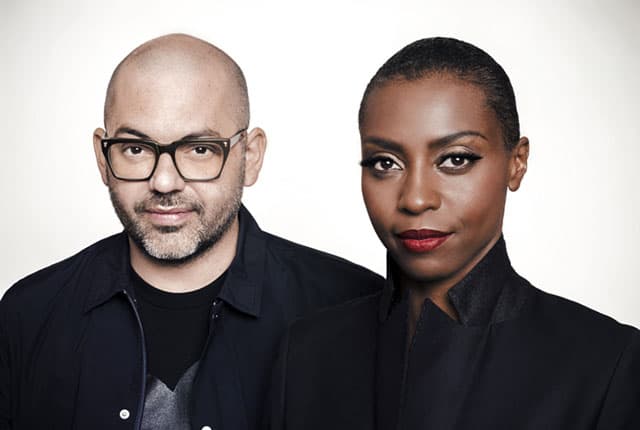
Finnish filmmaker, composer, and musician Diana Ringo returns with Clowns in America, a synth-driven album blending post-punk, darkwave, and industrial influences. Using dystopian imagery, dark satire, and theatrical storytelling, Ringo explores the contradictions and anxieties of contemporary life through a distinctly cinematic lens.
A classically trained pianist, Ringo has composed award-winning film scores, directed several feature films, including an adaptation of George Orwell’s Nineteen Eighty-Four, and released her debut post-punk/darkwave album, Cyberwolf, in 2025.
In this email interview, Ringo discusses the inspiration behind Clowns in America, the ways her film and music inform one another, and why she believes art should leave listeners with questions rather than easy answers.
You’ve now explored dystopian ideas in your films, earlier releases, and Clowns in America. What keeps drawing you back to these worlds?
Diana Ringo: We are all drawn to romanticize the fantastic future — with flying cars, cities on Mars, and friendly, or not-so-friendly, robots. Artificial intelligence is now here, it’s 2026, and many of the greatest sci-fi writers could only dream of what is happening today: pocket-sized computers connected to a global network, machines that converse like humans, reusable rockets, gene editing, brain-computer interfaces, humanoid robots, self-driving cars, and global satellite networks. However, there are still no flying cars or teleportation. Through the Epstein files, we see the elites with dirty hands, yet no one is getting arrested in the US. Evidence of aliens is now being paraded by the American government. Nevertheless, when we think about the “fantastic future” and dystopian narratives, we see that the main ideas have always been present in our society. The things that once belonged to science fiction — non-stop surveillance, algorithmic manipulation, manufactured realities — are simply woven into everyday life. We give up our privacy for text messaging, feeding the beast our own flesh.
What I find funny is that technology advances unevenly, in some areas everything accelerates, but in others — especially energy, resources, and infrastructure — things feel stagnant as we still rely on the same basic power structures and centralized systems. Where are the real shifts in how energy is produced and distributed? Instead of transformation, we often get slightly faster tools built on very old foundations. A “Mad Max” kind of future doesn’t feel so far-fetched.
History is being rewritten minute by minute as books are fed through recycling systems, and online, everything is deleted all too easily. Anyone can be canceled and turned to dust at a moment’s notice. Dystopian imagery simply gives me a language for exploring these anxieties. I’m just trying to understand the brave new world we’re already living in.
The album explores illusion, identity, technology, and spiritual decay. Were these themes consciously planned from the beginning, or did they reveal themselves as you wrote?
Diana Ringo: At first I didn’t know what I was going to write about; I merely tend to follow my curiosity. Reptile was the first song I wrote; although I ended up rewriting it over time. I approached it as a kind of ‘love song’ in the beginning. Reptiles survive everything. Aren’t they wonderful? They feel prehistoric, almost outside of time. To think that they existed millions and millions of years before humans ever walked the Earth is awe-inspiring. I was interested in how reptilian imagery continues evolving through culture; ancient civilizations worshipped serpent figures as symbols of rebirth and forbidden knowledge, while reptiloid mythology continues to fascinate people even today. I must say that many politicians do resemble reptiles, but not as cute of course.
The themes weren’t planned — songs arrive first, and only later do I realize they are circling something larger. The subconscious understands before the conscious mind does. Looking back at the album, I can see connections that weren’t obvious to me while I was writing it, I was even surprised to notice I had mentioned clowns in Fracture, before writing Clowns in America. It was like discovering a map after already walking through the territory.
Clowns in America was the last song I wrote for the album. As I was almost finishing it, I found out that the CIA is often referred to by its employees as “Clowns in America” — that’s when I realized I needed to make this track. I also knew there were still things I wished to say about America, society, alienation and disillusionment. The clown became an important symbol for me because clowns are funny and unsettling at the same time. They entertain us, but they also expose the absurdity of the performance. In many ways, that’s how I see modern life.
Many of the songs I write come from a place of anger; there is so much unfairness in the world, and writing songs helps me process everything happening around me. Palaces are built for those who do nothing, and a shovel is the only reward offered to the men who built them. Justice often feels dead, or at least asleep—sometimes you want to shake her awake. I also feel it was a breakthrough for me as an artist when I realized that anger, frustration, and other negative emotions can be channeled into songs. As a vocalist, I know that if there is no emotion in the voice, the track is dead.
Looking back, I think many of the songs are really about belief. People don’t stop believing; they simply redirect their faith — into politics, celebrities, science, technology, money, ideology, identity. Human beings are meaning-making creatures. The symbols change, but the underlying impetus remains. I think a great deal of modern life is shaped by what happens when spiritual needs are redirected into secular institutions. We still search for meaning, we still want to belong, and we still long for something larger than ourselves. The questions remain the same, even when the answers change.
I started recording in January, and the album took around three months to make. I don’t rush the process, but I also don’t like staying in one thing endlessly — I just trust that gut feeling when I sense a song is finished.
Many of these songs seem to exist in a space between satire and genuine despair. How do you balance those two impulses in your work?
Diana Ringo: I don’t really treat them as two separate impulses, in reality, they arrive at the same time. Some of the darkest, most disturbing things happening in the world are just so… absurd! Modern life can feel like a joke delivered by someone who has forgotten the punchline, but is still committed to the performance. When the house is on fire, arguing over the color of the curtains does seem superfluous, yet the argument continues, because it is easier to negotiate aesthetics than to confront the failing structure itself. Humor becomes a survival mechanism in difficult times, as people often produce the funniest things in moments of deepest instability. If everything is pure despair, it becomes exhausting. If everything is pure satire, there is no emotional center, and it becomes too superficial. The thin line between laughter and dread is where many people actually live.
One of the ideas that runs through the album is that we’re increasingly “plugged in to be alone.” Has technology fundamentally changed the way we relate to one another, or has it simply amplified existing human tendencies?
Diana Ringo: Probably both. Human beings have always struggled with loneliness, vanity, tribalism, and the desire for validation. Technology plugs into these instincts and industrializes them. It transforms private weaknesses into economic systems for public consumption. We are more connected than ever and often more isolated than ever at the same time. People consume sex and murder through the internet, and relationships become transactional — pursued not out of love, but for status. That’s one of the central contradictions of contemporary life. Everyone is connected, but there is not enough love in the world. That’s what my song Titanic is about.
Your background in filmmaking seems to naturally extend into your music. You describe each song as feeling like a scene from a larger dream—was there an overarching narrative or visual world connecting the album, even if it wasn’t explicit?
Diana Ringo: Yes, I do think that every song can be seen as a fragment from a nonexistent film set in a dreamlike world of circuses, political madness, theater of war, religious symbols, and reptiloids lurking behind reflections. There is a shared atmosphere of a mysterious underground society that trades souls for financial gain — a sort of carnival of souls — and of people trying to survive this place. The soul is the most valuable thing we humans have, and when one sells it, the person is doomed, even if they live in a house worth hundreds of millions of dollars and have a billion-dollar bank account. Price of Admission is the song that connects the narrative.
As someone who writes, directs, edits, composes, and creates visual art, do you ever find yourself needing to protect one discipline from the others, or do they naturally coexist?
Diana Ringo: They live quite peacefully side by side. To me, they’re just different ways of exploring things I’m passionate about. Sometimes an idea wants to become a song. Sometimes it wants to become a film. Sometimes a painting. When you make a film, you are reliant on a multitude of external factors, and what I particularly enjoy about music is its freedom — it can serve as a supporting structure for a larger body of work, or it can exist entirely on its own, without needing to explain itself.
At the same time, my work in one medium inevitably influences the others. As a filmmaker, I think visually when I write songs. As a composer, I think about rhythm when I edit films. Visual art influences the way I construct imagery in lyrics. They are all connected by the same curiosity and the same desire to understand something that fascinates me. The medium changes, but the urge to create remains the same.
Working on Nineteen Eighty-Four immersed you in Orwell’s ideas about power, truth, and control. Did any of those ideas find their way into Clowns in America?
Diana Ringo: Absolutely, those ideas did find their way into Clowns in America. Every day I see the things Orwell warned about playing out around us. He remains relevant because he understood something fundamental about human nature and power: the technologies change, the slogans change, the faces change, but the underlying mechanisms remain the same.
Newspeak is practiced today all the time; words increasingly carry different meanings depending on who is using them and for what purpose, while more and more expressions are deemed unacceptable or beyond discussion. There is also a kind of conditioning in how people are taught to view conflict itself — war is framed as virtue, something noble and necessary, and being against it can easily earn you the label of a traitor. Orwell captured this phenomenon with chilling simplicity: “War is peace. Freedom is slavery. Ignorance is strength.” The desire of ruling classes to reshape reality by reshaping language is very real. That tension between appearance and reality runs throughout Clowns in America. The title track speaks of “walking tightropes made of lies” and “juggling headlines, alibis,” while warning that “strings get pulled you never see, as the hands move oh so silently.” On the surface it’s circus imagery, but underneath it asks a very Orwellian question: who controls the narrative, and who benefits when truth becomes performance?
What makes Nineteen Eighty-Four so enduring is that he wasn’t simply writing about one government or one historical moment; he was writing about patterns that surrounded him, that surround us now, and that will surround future generations as well. At the same time, I do think modern society contains elements of both Orwell and Huxley. Control doesn’t always arrive through brute force; sometimes it arrives through sedation, algorithms, and a culture of constant stimulation.
Your music has a strong theatrical feel, with powerful yet relatively minimalist electronic elements. What influences informed the album, and what was your creative process like as Clowns in America took shape?
Diana Ringo: Musically, I was inspired by Nico, David Bowie, Siouxsie Sioux, Gary Numan, Killing Joke, post-punk, synth-pop, industrial music, and experimental music. I get inspired by many different kinds of music, and if I tried to list everything, the list would be endless.
For me, everything begins with lyrics and emotion — and the bassline, of course. Then I build the music around that feeling, layering sounds until the song develops its own personality. I try to leave room for mystery rather than explaining everything. I compose songs differently from instrumental pieces, since the voice should guide the composition — it’s something I had to get used to when I started making songs rather than pure instrumentals. Another thing I realized when I started making songs is that less is more; there is value in minimalism. The instruments should not overpower the vocals. If I get the right vibe on the first take, I keep it. If I don’t, I work until I get the right take — it’s not about clinical perfection, it’s about getting that perfect “imperfect” sound. I record everything at home since I have a home studio and it’s the most comfortable environment for me, and I don’t have to worry about mistakes or retakes.
You have a classical piano background but work comfortably within darkwave and post-punk. What do those worlds give you that classical music alone doesn’t?
Diana Ringo: Bach, Beethoven, and Chopin taught me the ABCs of music, and this foundation is invaluable. I think people sadly underestimate the importance of childhood musical education, which can shape your whole life for the better — I know that without it, I would not be able to do what I do now. However, the classical music world today is very much a museum of antiquity, and I was never interested in living inside those beautiful walls exclusively. Art that is safely dead and trapped in a gold frame is harmless; it’s the living contradiction that breaks the window. That’s why I initially gravitated towards film music; it allows for endless experimentation since all genres can be utilized. I love synthesizers, they can sound seductive, mechanical, cold, euphoric — sometimes all at once. I love writing lyrics and I love singing. Electronic music opened entirely new worlds for me, and its endless potential continues to fascinate me.
Darkwave, punk, industrial, and post-punk allow for a different kind of freedom. They welcome imperfection, experimentation, complexity, ugliness, contradiction, and raw emotional energy. And most of all, I want to hear new things all the time. The great composers of the past were innovators in their own time, the rock stars of their era; they are still remembered because they were different, not because they “fit in.” I think the best way to honor that spirit is by continuing to explore new sounds, and new ways of expressing what it means to be alive today, in this very moment.
In another interview, you said that you try never to repeat yourself. What scares you more as an artist: failure or repetition?
Diana Ringo: Repetition, definitely. Failure can be overcome and quickly forgotten if you’re attempting something new. The more dangerous trap is when something you’ve done is well received and you begin to reproduce it again and again, until it slowly turns into a template you’re expected to follow, and what once felt alive becomes stagnation.
?What people sometimes don’t see is that when an artist seems to become “understood,” the work starts to lose its substance. Once everything becomes predictable, once people feel they already know exactly who you are, the space for surprise disappears, and with it the sense of innovation. I am not a machine meant to endlessly replicate itself. As an independent artist, I have the luxury of trying new things all the time without anyone telling me that what I’m doing is “wrong” or that I should be doing “this” instead. I learn as much from failure as from success. Growth can be uncomfortable, but staying within a fixed pattern is the true failure. Art should always remain slightly unpredictable — especially to the artist creating it.
What do you hope listeners will carry with them after experiencing Clowns in America from beginning to end?
Diana Ringo: Awareness. Questions rather than answers. I don’t want to tell people what to think — I want them to look at the world a little differently afterwards. If the album encourages someone to question the world and search for what exists underneath the surface, then it has done its job. I don’t want the listener to leave the album feeling satisfied; I want them to realize that the circus isn’t on the stage — it’s waiting for them on the street outside.
Art should not be an anesthetic that helps you endure a miserable reality; it should be an adrenaline jolt. I understand that every song I make will make each person feel different things, and that’s one of the things I love most about music. A song is a microcosm in itself. Once it’s released, it begins a different life inside the imagination of each listener.
Clowns in America can be found on Bandcamp and Spotify. For more info on Diana Ringo, vist dianaringo.com.