

Rare DM’s new album Attention finds Erin Hoagg pushing the project further in nearly every direction, expanding both the production and emotional range of her synth-driven sound while continuing to develop the distinct visual identity that surrounds it. Since emerging with the 2021 debut album Vanta Black, Hoagg has steadily expanded Rare DM through extensive touring and a string of standalone singles and videos, drawing from synthpop, darkwave, club music, and cinematic textures. Created in her home studio, Attention reflects Hoagg’s focus on hardware synthesizers and drum machines, shaped further by years of touring, experimentation, and evolving studio techniques. At the same time, the album maintains the immediacy and atmosphere that have defined Rare DM from the beginning.
One of the more interesting aspects of Attention is the way Hoagg approaches vocals differently from track to track. At times they’re intimate and upfront, elsewhere they drift deeper into the overall texture of the music or function more as part of the soundscape than a traditional lead vocal. That openness carries through the production as well, with Attention pushing the project’s sound further while resisting the kind of over-polished perfection that can flatten electronic music. The album also reflects a more collaborative approach than earlier releases, particularly through Hoagg’s work with producer and engineer Ross Fish, aka Møffenzeef Mødular, whose contributions helped sharpen and expand the material without losing its character.
Speaking via Zoom, Hoagg discussed the gradual evolution of the album, learning to take greater control of Rare DM’s visual side through self-edited videos, the realities of touring Europe versus the United States as an independent artist, and her appearance in The Bride!.
Last time we spoke, you were putting out singles and didn’t have concrete plans for a second album. Could you talk about the overall evolution and timeframe of this album?
Erin Hoagg: Kind of the thing that ties all of this album together is that it was all done from the same studio in my last apartment. And I was there for a very long time. Basically, all of these songs are at various stages of my studio’s development. Through international touring — and I guess I did more in Europe than I did in the US over the last couple of years — I’ve really been able to hone my craft through both the loneliness of the pandemic and the touring experience itself. I think that heavily influenced my writing and production style. So basically, this album is a natural progression toward making the music I actually wanted to make but hadn’t necessarily made yet.
The other thing that’s really changed is that I know how to edit videos now, and I edited my last four videos: “The Ring,” “Skater Hits Me Harder,” “Compliment,” and “Honey.” That’s been really cool because it’s a new way for me to do even more with my visuals, since now I can micromanage that too instead of just the music.
Does that visual aspect affect the way you make music? Do you tend to have visual ideas in mind while writing, or are songs ever shaped by ideas you might have for a video?
Erin Hoagg: I would say it’s more that from the start of a song, I already have a visual in mind. For example, the song “Skater Hits Me Harder.” That song has a line in it that says, “Fuck me on the bookshelf just like Atonement.” I was always inspired by the movie Atonement and the bookshelf scene, as well as real-life experiences. So with that one, for example, I was like, ideally the video would involve a bookshelf, a pretty dress, and a man in a suit. That was the first of these videos that I edited myself. I wouldn’t say it turned out perfectly, but I am happy with it.
I don’t write music specifically to already have a visual in mind, but sometimes the music is inherently visual.
You mentioned that you’ve been performing more in Europe than in the States. What are some of the reasons for that?
Erin Hoagg: There’s a big one, and that is that Europe gets your hotel. No hotels in America. America is like, “Hey, here’s two drink tickets, and we won’t get your hotel. We won’t help with your flight. We won’t help with your local transportation. And also we want to do a door deal instead of a guarantee.”
So not only is it financially riskier, but as a solo artist, the United States is too big. I can’t do all that driving by myself. It’s just not safe. I’m still a single woman in a car. Not only would it be too taxing to do eight-hour drives by myself and then play a show, but it’s also kind of unsafe to do that in America. Whereas in Europe, I can hop on a train.
Usually I take trains, though sometimes buses. But I very much prefer trains. And they’ll usually cover your local transportation too, like Ubers from the station, which is awesome. Touring is financially risky sometimes, and at some point that becomes the main source of income for a lot of artists. If I’m going to take that risk and possibly lose money, I’d rather lose money in Europe than lose money in America.
I’m sure that direct audience feedback must have some influence on you. Has the fact that you’ve performed more in Europe shaped your music in any particular ways?
Erin Hoagg: I would say my music has always appealed heavily to European audiences. I also always had a lot of Russian and Ukrainian listeners too. So I think my sound was already headed in that direction. Whatever it is they like about me, it’s there.
I don’t tailor my music for people. I make it the way I want to make it. But I would say I tailor my live performances for people. So it has affected things like set order. I might do something slightly clubbier depending on the venue or showcase. So I’d say that’s more vibe-dependent than people-dependent. Maybe Europe just has slightly more rave energy to it sometimes, if that makes sense.
You mentioned this album was made in the same apartment and studio setup. Were there ways your approach or tools differed from your previous work?
Erin Hoagg: First of all, I found a collaborator that I really love. I’ve been working with Ross Fish, aka Møffenzeef Mødular. He’s an incredible synthesizer designer, sound designer, producer, mixer, and mastering engineer. He mastered every song on the album, and mixed and produced most of them with me.
Basically, I’d have a song that was beyond a demo because the arrangement was done and I’d already recorded all the instruments. Then Ross would say things like, “You’ve got too many basses in this part,” or “You’d benefit from leaving this one out,” or “Can we retake your vocals?” He can tell things just from listening, like if my mouth was too close to the pop filter. Then I’ll have to redo the take.
Having such a professional audio engineer on the team, so to speak, has really leveled up my music. Another interesting part of it is that he doesn’t believe in Auto-Tune or Melodyne. I used to feel insecure, wondering if my voice was good enough or in tune enough on the early singles and first album. Ross has been like, “No, fuck that. We’re not doing that. You sound great. Just do a take that you like.” And people have liked the songs. That’s felt really nice because it’s more vulnerable in that way.
Another difference from the first album is my recording setup. On Vanta Black, I only had two to four inputs at once. So when I recorded my drum machine, the snare, bass drum, and cymbals would all end up on the same track with no separation. Now I’ve got 16 channels to work with, and I record all the drum sounds individually so they can each be mixed separately. That’s been a huge level-up. I think that started changing around some of the singles too. I think “Send Nudes” had that change as well. But it’s definitely a major difference from the first album.
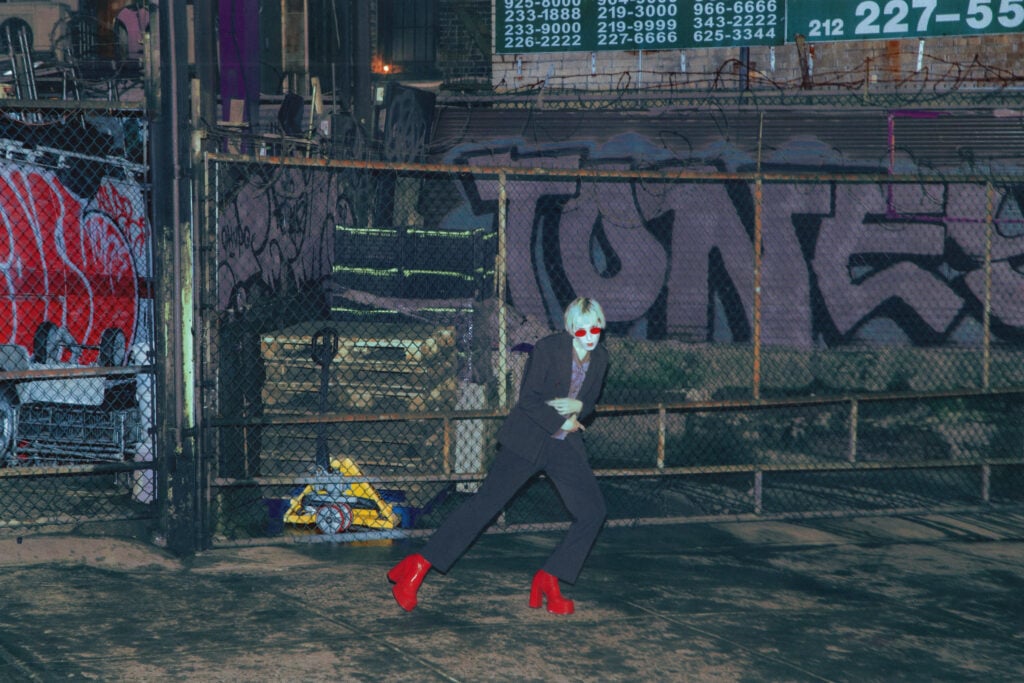
Photo by Lissyelle Laricchia
Listening to this album, there seems to be a lot of variety in the way vocals function within the songs. Sometimes they’re very upfront, while other times they feel more like part of the overall texture. Is it usually obvious while you’re composing what role the vocals will play?
Erin Hoagg: Oh, that’s a great question. Sometimes a song naturally ends up with a certain type of vocal because maybe I do a magical scratch vocal that just stays forever because I can’t replicate it. That happened on “LA Traffic” and “The Ring.” I wasn’t going to be able to duplicate the magic of those first takes. I think “Honey” was another one where I was like, “Oh, I really love that.” I’m not even sure if we retook it.
Other times, you use certain vocal effects because that’s what serves the song. Maybe the song just leans toward wanting a vocal that’s less upfront. Other times, you want the vulnerability and contrast of having the vocal super upfront.
With “Butterfly Historian,” for example, that song has always felt very lo-fi to me. I tried to recreate the vibe of the original take, and it was a vulnerable, softer vocal that needed some stylistic aspect to it. Ross added a nice filter effect similar to what he did on “325.” Then there are other songs where it’s better if the vocal is more bare. Or I’m always just like, “More reverb, more delay.” It all depends on the song.
I think some people feel really restricted and want their vocals to sound the same across the board, but I just don’t write like that. That’s not my thing.
Is this album self-released, or are you working with a label?
Erin Hoagg: I’m working with a distributor. My friends Max and Dina at Iptamenos Discos in Berlin are digitally distributing the album. It’s nice because they can actually give my music a better chance of being heard. They have their own label, and when they fully sign an artist, they have a very specific visual identity and a much more hands-on approach, including making the records.
The timeline was too short for that, and I’m still pretty set on maintaining a certain level of independence until the stars align or whatever. But I’m really happy to be working with them because they know how to do things like — and this sounds stupid — getting your album on Spotify so people can pre-save it. That’s something I couldn’t do before.
So it’s kind of both. I’m technically still independent, but it’s nice having people behind the scenes who know how to do things.
You appeared in the movie The Bride!. How did that come about, and is acting something you’d want to pursue further?
Erin Hoagg: The way that happened is my friend Andrew Segreti, who’s a very talented photographer, was acquainted with one of the music supervisors — or whatever her exact role was. She had a big part in finding Fever Ray’s band for the movie. Apparently she saw a photo Andrew took of me in 2021 or 2022, and The Bride! was filmed in 2024. She was like, “Who is this girl? Is she a musician? She’s got exactly the look I’m looking for.” Apparently I was her first call, which was such a huge compliment.
I had the time of my life doing that. It was magical seeing how much attention was paid to detail. Honestly, it made me understand how movies become so expensive. Every single extra in the bar scene had continuity down to their exact drinks across both shooting days. Everyone’s makeup was constantly being redone. It was movie magic, and I loved it.
There’s also a Fever Ray music video that features the band a bit more. Everybody was super nice and inspiring. I met Maggie Gyllenhaal, and Christian Bale personally thanked the band individually, which was really cool. I’d absolutely love to do more acting. It was incredible.
It also seems like your music would work really well for sync placements. Is that something you’ve pursued?
Erin Hoagg: That would be awesome. I’d love to. That’s another thing I’m working on with Max and Dina. They have music publishing through La Chunga, and they now have my catalog, so fingers crossed we can get some placements through that. That’s pretty exciting.
For more info, visit raredm.com.


