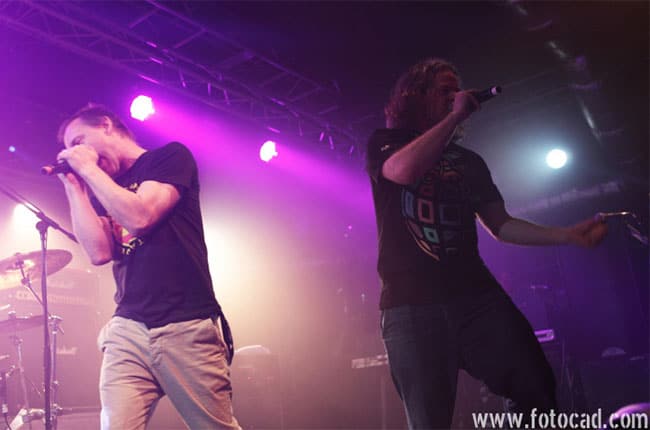
Scenius is an Anglo-French electronic duo formed by UK producer Steve Whitfield and French vocalist Fab Nau, combining vintage synth textures, post-punk atmosphere, and modern electronic production into a sound that feels rooted in several eras without being overtly retro. Drawing from early electronic music, post-punk, synth-pop, and more contemporary electronic production styles, the group has developed an approach defined through vintage synthesizers and drum machines, avoiding guitars, live drums, and sampling altogether.
Originally conceived as a studio project, Scenius have gradually expanded into a live act, building momentum through performances in France and the UK, including a 2024 support appearance with The Mission at the invitation of Wayne Hussey. More recently, the duo secured the opening slot for Midge Ure’s full UK tour through a direct email to the tour’s team, leading to a 21-date run through venues including the SEC Armadillo, Bradford Live, and Edinburgh’s Usher Hall.
Ahead of the tour, Scenius released Five-Arm Crystal (Sixth-Arm Mix), a darker and more club-oriented reinterpretation of an earlier track that reflects the band’s interest in allowing songs to evolve beyond their original studio versions. That same approach carries into their live performances, where songs are allowed to shift and evolve rather than being recreated note-for-note. With a third album, 13 Billion Dark Years, arriving later this year, Scenius continue to refine a sound that balances melodic accessibility with the darker edges of synth-pop and post-punk.
The following is an email interview with the band.
Your music clearly draws from classic synth and post-punk influences, but it doesn’t feel nostalgic in a retro-copycat sense. How do you balance honoring those inspirations while still sounding contemporary?
Fab: The whole point for us, right from the beginning, was to merge three elements that we both love in music: the sound of analogue synths and drum machines that were made popular by all-synth acts like Kraftwerk and Jean-Michel Jarre, the slightly twisted, anti-rule, sometimes dark way of composing and arranging songs that came out of the post-punk era, and then a more 2000s approach to producing and mixing music.
Steve: On top of that, we’re also huge fans of great melody writers, from Bach to John Barry to The Beatles. I suppose putting these exact same elements together just happens to be something that not many bands have cared to do yet, which might be why it sounds like our own thing and not strictly retro.
Really, though, we’ve just gathered together things that were already there for anyone to harvest!
Supporting Midge Ure feels like a natural fit for Scenius. Were there particular Ultravox or Midge Ure records that had a lasting influence on your approach to electronic music?
Steve: I think it’s hard to overstate the impact that Ultravox had on how electronic music and synth-pop developed in the UK. What they were doing with records like Vienna or “Dancing With Tears in My Eyes” really helped define what a synthesiser-led band could sound like in a mainstream context — not just as an experimental idea, but as something emotionally direct and very structured in a pop sense. And of course, Midge Ure played a key role in that, particularly in bringing that balance between electronic textures and strong songwriting to a wider audience. I wouldn’t say it’s about influence in a direct or conscious way for us, but more that it helped establish a language for synth-based music that everyone working in that area has inherited in some form.
Fab: For me, it would be hard not to pick “Fade to Grey.” Growing up in France in the ’80s, that song was both a massive hit and something that felt completely groundbreaking at the same time. Not to mention how mesmerised we all were by those slightly cryptic French lyrics delivered in such a lovely accent 🙂
It’s definitely had a lasting influence on electronic pop in France. In fact, I think you can still hear traces of “Fade to Grey” in a lot of songs by Air, Kavinsky, and artists like that.
Your setup deliberately avoids guitars, live drums, and sampling. Was that limitation something established from the beginning, or did it evolve naturally over time?
Fab: Yes, it was established right from the beginning that we were only going to use analogue synths and drum machines. And so far we’re still having fun with that limitation, and we’re still finding new ideas and new paths to explore within that original framework. But it’s not as if we swore never to use a guitar, a bass, real drums, or a sampler. In fact, we both love playing all of those instruments as well, so they could definitely sneak into a song or two sooner or later.
What are some of the vintage synths or drum machines that have become essential to the Scenius sound?
Steve: I do have a small collection of old synths, and I love them all, but over the last few years my favourite has probably been the ARP Odyssey. A huge part of the last two albums was done on that synth. One thing I really love about those older machines is that there are no preset sounds, so you’re forced to learn them inside out and build your own sounds from scratch. Most of the sounds I use are tailor-made for each song, although a few patches end up being written down or memorised so they can reappear later in different forms.
I also use a really rubbish Casiotone 202 from time to time. Most of the sounds on it are honestly awful, but there are a couple that I really like, and once they’re heavily processed they can sound fantastic. Even the cheapest, most broken-sounding keyboards usually have at least one or two great sounds hiding in them.
Are there any particular other projects you’ve been involved with that have influenced or shaped what you’re doing with Scenius?
Steve: I don’t think I’ve consciously brought many other people’s soundscapes into Scenius, but I’ve definitely learnt a huge amount from almost everyone I’ve worked with over the years, just in different ways. Sometimes it’s about arrangement, sometimes production, sometimes simply about attitude and attention to detail. Working with The Cure in particular was very educational for me, because Robert Smith is such a clever and meticulous person. He really doesn’t let any detail go unchecked, whether it’s a sound, an atmosphere, or the emotional impact of a song. Seeing that level of care up close definitely leaves an impression on you.
The new remix, “Five-Arm Crystal (Sixth-Arm Mix),” pushes things in a darker and more club-driven direction. Did reworking the track reveal something new about the song that wasn’t obvious in the original version?
Steve: When we created the original version of “Five-Arm Crystal,” we already felt there was a darker, more club-oriented side to the song. But that direction wouldn’t quite have fitted within the overall context of the album, so we kept in mind that we might eventually revisit it later as a stand-alone remix.
We’ve always enjoyed working on remixes — whether it’s our own tracks or someone else’s — because it allows you to look at a song from a completely different angle.
So when we got the support slot for the whole Midge Ure tour and started thinking about releasing something new for the occasion, while still keeping a connection to the last album, that remix idea immediately felt like the right choice.
There’s often a tension in electronic music between precision and emotion. Do you think modern production tools have made it harder to preserve personality and imperfection?
Fab: Well, first of all, nowadays, because you can manipulate audio almost as easily as MIDI notes, that tension probably applies to all kinds of music, not just electronic music. But the tools themselves won’t automatically make things over-clean, overly tight, or lifeless unless that’s actually what you want them to do.
As for us, we tend to keep everything that isn’t programmed — lead synths, vocals, and sometimes even bass synths or extra rhythmic elements — completely unquantised, precisely because we believe personality also lives in mistakes and imperfections.
Because Scenius began as a studio project, what was the biggest challenge in transforming it into a compelling live act? How do you approach adapting the music for a live setting?
Fab: Actually, we really were expecting it to be quite a challenge. We thought we’d probably have to spend hours, maybe even days, reworking each song before we’d genuinely enjoy the live versions and feel comfortable playing them on stage. To be honest, when Steve suggested we give it a try just after releasing our debut album, I even thought there was a chance it simply wouldn’t work at all and that we’d remain purely a studio band.
But as we went through the songs one by one, it turned out they only needed very minor adjustments to come alive in a live setting.
The biggest challenge then — and still today — is staying faithful to the atmospheric, intimate side of the music while also giving the songs enough energy and presence to really work on stage.
What is in the future for the group after this tour?
Steve: We’re really looking forward to getting back into writing mode after the tour. We’ve already got around eight new songs that are fairly advanced, so there’s a lot we’re excited to develop further over the coming months.
CONNECT WITH SCENIUS : Facebook | Instagram | Spotify
Scenius are on tour with Midge Ure though June 5, 2026. For dates and tickets visit https://midgeure.seetickets.com/tour/midge-ure.