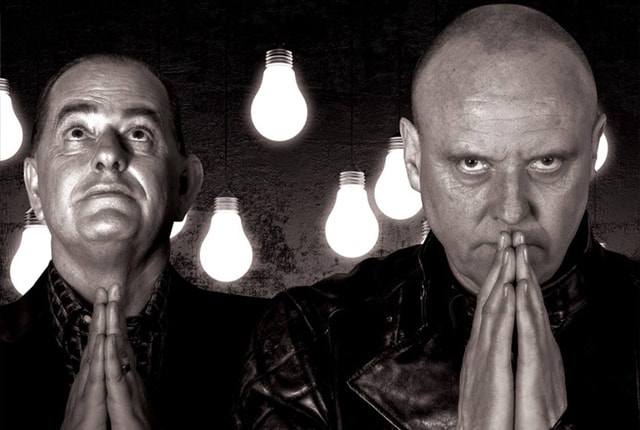
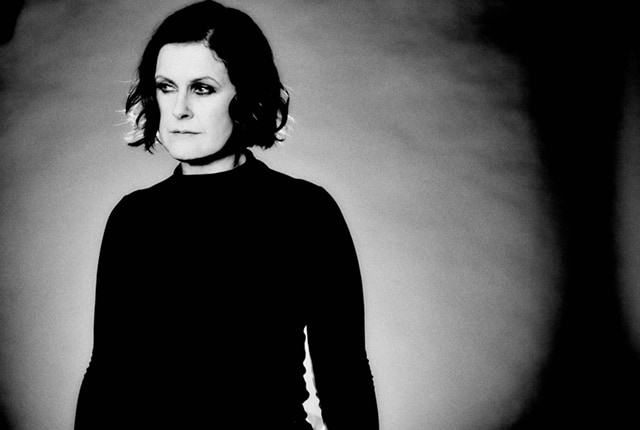
STABBED BY PRONGS is the dark electro project of Craig Drabik, drawing from EBM, industrial, and other electronic influences. On his latest album, Static Skin, he writes the music himself while leaving the lyrics to his collaborators, so the project comes together in a way that’s less about a fixed concept and more about what emerges as the tracks take shape. He describes it as a kind of shared “zeitgeist” among the people involved. The result moves between aggressive material and more melodic, dance-oriented tracks, with the occasional unexpected turn, like a cover of “Come As You Are.”
In an email interview, Drabik discusses his creative process and the making of Static Skin.
There’s a consistent focus on human relationships throughout Static Skin. Did that come from a specific idea or evolve over time?
That’s an interesting question for this project! I compose all the music, but on Static Skin each of my vocalists brought their own lyrics to each song. I didn’t have any influence on what they decided to write about. You could say that any themes which emerge are accidental, but I don’t think that’s entirely accurate. I think it’s more like.. A zeitgeist that my collaborators are all tapped into. In other words, it’s representative of what people are experiencing in their lives and not just simple chance.
For me this is actually one of the more interesting aspects of putting together an album or EP: I get to watch the themes unfold organically as the tracks come back from the vocalists!
You’ve described the album as having “two personalities” between male and female vocals. At what point did that duality become central to the project?
The duality began quite early in the process. I wrote two long-form instrumentals for a segment on Colin Spencer’s show called “Three Originals By Each” where I talked about my favorite Front Line Assembly tracks. I needed a third to make “Three Originals” so I repurposed a track left over from my last record to make three. Those songs were dancier, trippier, more pop oriented – more dark than heavy.
I wrote the other three original tracks on the album almost as a response or counter-balance to the three I wrote for Colin’s show. I wanted them to be heavy and gritty and grimy. I wanted them to take more influence from EBM and industrial than coldwave or futurepop. I tried to match the vocalists I had available to me to the songs that I felt they’d be best suited to, and it just shook out that the women got the dancier stuff and the men got the heavy stuff. Next time I’m going to give Kimberly the nasty stuff and Lail will get the futurepop!
There’s a noticeable contrast between heavier tracks like “Corpus” and more atmospheric ones like “Pyromancer.” How deliberate was that balance when shaping the album?
I certainly did want the record to balance. It didn’t necessarily have to be three and three (setting aside “Come As You Are”), but I didn’t want it to feel like a futurepop record with a random industrial track tacked on or vice versa. It’s important to me that a record takes the listener on a journey. If you’re going to put out 7 songs at once, to me it’s boring if they all sound or feel the same.
The record pulls from EBM, electro, and 90s industrial influences. Could you discuss the influences behind your sound on Static Skin, both in terms of artists or records, and how your chosen tools shape your style?
My primary influences definitely go back to the 90s, when I first discovered industrial. Seeing NIN at Woodstock ‘94 started it all, and from there it was a short hop to bands like KMFDM and Front Line Assembly who are two of my favorite bands and biggest influences. At that same time, you had this little moment in pop music where you had groups like The Crystal Method, The Prodigy, and Fatboy Slim having breakout success in pop music. Those artists have also influenced my music.
I work primarily in hardware when I’m composing, and I own an awful lot of the gear that those artists would have used back then like the Access Virus and Nord Lead – both of which I’ve owned since the early 2000s. I also have some clones of some of the classics like the Roland TR-909 drum machine and the 303. I also specifically chose to work with samples of some of the old-school drum machines that were popular with EBM and industrial bands in the 90s.
Certainly, using the same stuff that my influences used back in the day does help to bring some of that flavor into my music. I try to keep one foot in the classics and one foot in modern production techniques and overall vibe at the same time. I don’t want to rehash the late 90s, but to sort of pull that style of music into the modern day,
The other thing I personally find interesting when I think about how my influences have translated into my music is that there are other less visible influences that manifest in my music that might surprise people. There’s a bit of my love for prog rock in the long-form structure of Pyromancer. There’s a big helping of riff-based hard rock and metal in tracks like Corpus and Big Fake World. The way I approach a track like Another Realm has as much to do with 80’s power ballads as it does with Delerium. Often I don’t even realize it until I listen back with some distance.
You’ve worked with a mix of returning collaborators and a new contributor on this release. How do those different contributions shape the overall identity of the project?
They’re hugely important. I can’t really overstate that. I can obviously set the vibe through the music, but the lyrics are what focus the vibe into a conscious, coherent message. I don’t shape the record’s meaning for the most part, they do. I owe all of them a huge debt of gratitude for lending me their talents.
Their contributions go even further than just taking what I’ve given them and laying down a vocal over the top of it. There’s always another round of production and arrangement after I have the vocal. The track can change substantially as a result of their input. They each have their own way of working too, and that influences how I approach the final production of the vocal. Ry White loves to give me like a zillion tracks of vocals, including weird noises and oddball phrases, or takes where he’s sung something in a weird voice. That means I can do things like creating a pop-style vocal stack for the chorus of Big Fake World. On the other hand, I typically only get a single take from Kimberly. That means I get to be creative with processing, and I tend to layer her with vocoders and synthetic vocal doubles. It makes a huge difference in how the finished tracks sound.
Your cover of Come As You Are stays fairly close to the original while translating it into an electronic context. What made you take that approach rather than completely reworking it?
I’d originally done that track for a compilation that never came out. I chose it specifically for that intro. In fact, I’d thought about doing Heart Shaped Box instead because I thought that kind of liquid, spaced out bass drenched in flanger would just sound amazing on either of those melodies. I also really wanted to push myself on the sound design for the heavy part – layering guitars and synthesizers into a slab of gnarly distorted sound. After committing to those two choices, I think it just naturally fell in place that it would hew close to the original.
Where did the album title Static Skin come from?
I picked it from the opening line of Big Fake World – “Carve my name into your static skin”. It just jumped out at me and I knew I had my title. So, thanks Ry!
Do you perform live? If so, how do you see these songs translating into a live setting?
I haven’t, but it’s something I’ve been considering doing. It’s a little tricky since I’m not physically located in the same place as many of my collaborators. I only want to play live if I can really pull together an actual live show – and both “live” and “show” are critical. I’d need to find a drummer and a female singer, and I’d like there to be a visual component to the show as well. I’ve got nothing against folks who get up on stage with just a laptop – in fact I admire their courage! For me though it’s not a compelling live show.
I’d also need to structure the show in such a way that we actually perform the music to the maximum extent possible. To me, it’s not live unless there’s a chance that the whole thing melts down if we do it wrong!
On the other hand, it’s really hard to attract listeners and build a fanbase if you’re not playing live.
I think there are quite a few songs that would translate well to the stage – certainly a song like Big Fake World is kind of riff-rock made with synthesizers and would be a natural fit. I think there are a few songs from my first record that would work well too, like Fail, or Deceiver, or Fall of the Empire.
With Static Skin expanding the project’s sound, does it feel like a step in a new direction, or a refinement of what you’ve already been building?
I think it’s refinement. I think this record feels more focused than my first record did. That first album was about me shaking the rust off and trying things and seeing what would happen. I hadn’t made music in a good 15 years before I did the first record. To be honest, I didn’t really know what would happen. Now, I’m much more able to focus on an objective and at least manifest something along the lines of what I was going for in the first place instead of just being surprised at what came out!
It sounds kind of crazy to say it this way, but I am now confident that there will be plenty more music to come, so I don’t feel like I have to cram everything into whatever record I’m working on. I can be more focused on one vibe or approach because there will be another opportunity to do something different next time.
Static Skin can be purchased at at stabbedbyprongs.bandcamp.com.