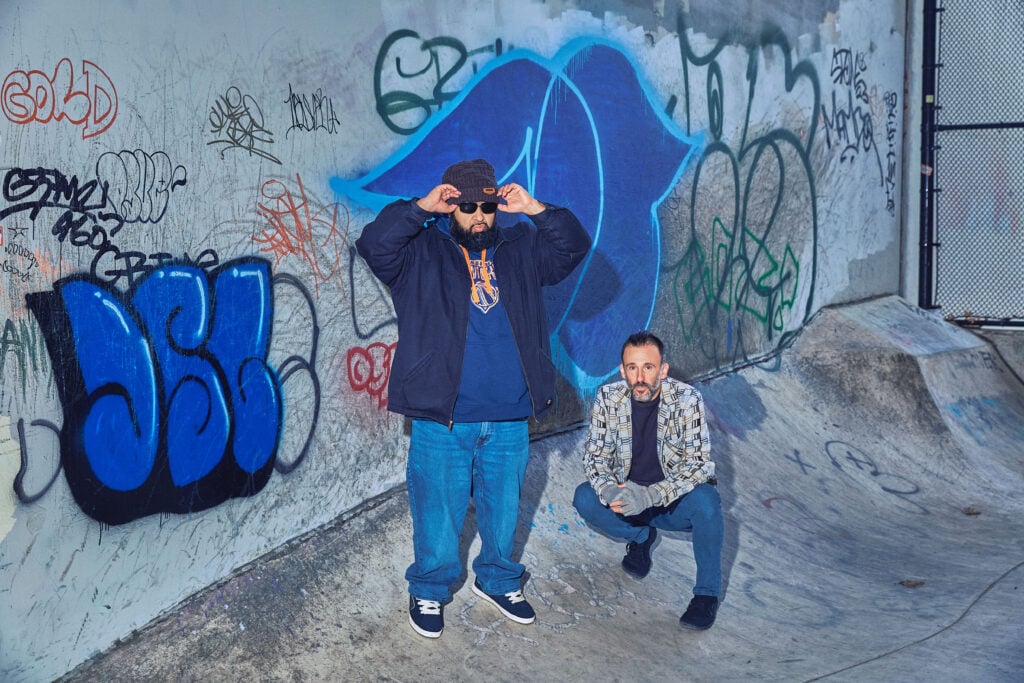
Since the late ’90s, dälek have been blending hip-hop with noise and industrial elements, building a sound that leans as much on atmosphere as it does on rhythm. Brilliance of a Falling Moon continues that, but with a tighter focus, built around the core interplay of classic MPC 3000 and effected guitar. It’s a more stripped-back approach, with tracks taking shape in a way that carries over directly into live performance.
The result is a record that feels more immediate and deliberate. It’s shaped by the current political climate, channeling frustration and anger, but also grounded in a sense of purpose, joy, and hope.
In the interview below, Will Brooks and Mike Mare talk about how this approach came together, how their process has changed over time, and how Brilliance of a Falling Moon fits into that. This interview was conducted on April 6, 2026, shortly after they returned from a series of European live shows. They will be performing in Europe again throughout April and May.
You just returned from doing some European shows. How did that go?
Will: It was great. Yeah, we got to debut a lot of the new material, the new album. And it was actually before the whole album came out. So it was definitely interesting to see what the reaction was going to be. And yeah, I was pleasantly surprised. It was good.
Did anything take you by surprise in terms of the reaction to this new material? Did you get any feedback that was unexpected in terms of the material they might’ve gravitated towards, or just in general?
Mike: We had decided we are going to play the whole album live. It doesn’t allow much time for a couple of decades of a back catalog. So I think the biggest surprise was how everyone was just so responsive and really loved the show. And that was without giving them quite possibly what they came to hear. The album wasn’t out at that point.
The album wasn’t even out, so they hadn’t even heard the new stuff. So it was completely just reacting to what they were hearing for the first time, without having heard anything beforehand. And for me, I feel like there was that one show where I kind of got the call and response going by the time we arrived on “Salvador.” And again, without them ever hearing that song before, which I was like, shit, it was definitely a powerful moment.
Are there any songs from this album that you think have a different feel or have taken on a new life now that you’ve performed them live?
Will: Not really. We kind of went into this album writing the songs with picturing what it would be like to play them live. So I think we went in already kind of mapping them out that way anyway. So it just kind of reinforced what we hoped it would be. Yeah, they sound the way I would hope they would sound live.
Mike: We approached this record with the idea that we would perform this music live, where in the past we would write songs and then we’d add other things to them live. To give them a different life so that you’re not just listening to the record. And the same holds true with this. But yeah, it was just like I think just us performing them live gave it a new life.
What does that mean to you in terms of the creative process when you’re making an album and thinking about live performance? Does that affect your approach and how you go about doing things in the studio?
Will: Well, I mean, I don’t know if that was the reason that we took the direction that we did with the album, but I think just the stripped-down nature of this album made each song and each sound that much more important. So there’s no unnecessary layers or sounds. Everything is there for a purpose and for a reason. And I think that in turn makes the live performance of it resonate that much more with me. I can’t really explain as to the why. There’s this heaviness to this album, but it’s also stripped down at the same time, which I don’t know if it was intentional because we wanted to play everything live, but it just gives it that much more weight in my mind when we play it live.
It does seem that throughout your career, you have performed more in Europe than in America. What’s the reason behind that?
Mike: Invitations.
Will: Support, finance. I mean, in all honesty, artists get paid better in Europe.
Mike: Get treated better.
Will: We’re playing festivals where you have thousands of people that want to hear what you’re doing. As a musician, you have to go where the crowds are. That’s the bottom line. We get a lot of, like, “Oh, why don’t you play in the US more?” But it’s like, okay, “So show up to the shows more in the US, book us more in the US, and offer us better fees,” and then I’ll play more. That’s the straight-up honest answer.
Mike: And the other part of that is, at this point, we don’t want to be on tour for months at a time, or even a month at a time, or weeks at a time. And the US is fricking massive. Getting from point A to point B takes a lot of time.
Will: And we did all that throughout our careers. I spent half my life in a van traveling the US, and on all the early tours we played every possible place we could play. If I was invited back under the right circumstances, I’d play anywhere in the US. I’d love to. But if it’s not there, and if the numbers don’t add up and it doesn’t work, then how can we? I mean, I’m a 50-year-old man. I’m not going to go out and lose money. I’m not going to go broke just because of the nature of the US, man. I never got into this to be famous or anything, and I didn’t get into this to be rich, but I’m also not here to be taken advantage of, and I know my work.
Do you feel that having more tour support in Europe has had any impact on the evolution of your music?
Mike: I don’t think that ever played into anything about creation.
Will: No. Well, I mean, the only thing I will say is that I guess the other musicians that we’ve encountered and collaborated with—that has come about because of the people that we’ve met overseas to a degree. That definitely does contribute. Because I think the people that you collaborate with always influence what you do from that point forward. So yeah, we’ve been lucky enough to work with really amazing artists.
Overall, how did the making of Brilliance of a Falling Moon compare to your previous work?
Will: Like we were saying, the stripped-down nature of this record—we kind of went back to the essence, where I was working strictly on an MPC 3000. Mike was doing effected guitar, and we were playing off of each other. And those basic ideas are the core of what the album is. And not that we didn’t have overdubs—there were a few—but they were more like accents. We weren’t adding layer upon layer like we used to—
Mike: Very much a live record, the music.
Will: Yeah. In a weird way, what was captured in the creation process is what ended up being the songs, just with a little tweaking. We would arrange after I recorded the vocals and then add just accents as far as overdubs. But what we recorded live is what ended up being the album. So in that sense, it’s different. In a lot of our other work, it was more building this monolith of sound that then we would strip away and sculpt into the album. Whereas this time around, it was like what we recorded was really what the album was. And then we just sprinkled in a few overdubs here and there just to accent things.
Was that a conscious intention going into it, or did that just kind of evolve once you started working on new music? What was the initial inspiration?
Will: I think it just happened. We were saying when you look at the total time, we probably worked on the album for two weeks, but it was spread out over maybe two years. And because of that—just time being precious and life getting in the way, and scheduling and all of that, and good things in life and bad things in life getting in the way—when we did get to work together, there was this intensity where we would just start creating. And each session created, I don’t know, 10, 15 different ideas, and we would just work that way until we were kind of spent that day. We would be like, all right, let’s just reconvene the next time. And the next time could be the next day or it could be a week or two out, but we would just work with that intensity every time. That, I guess, pressure or whatever just made the album be what it became.
And so I don’t think it was a conscious, like, “Oh, we’re only going to use this gear and that’s it.” It was just that we would walk in the room and that’s what we gravitated toward, and that’s what sounded good, and we just continued working that way. So I don’t think it was a thought-out plan—that’s just the way it happened.
Do you have a general process in terms of how the vocals and the music interact during the creative process? At what point do you tend to have lyrical ideas?
Will: Well, I think because Mike and I work on the music together and I’m the lyricist, even if we’re not recording the vocals in the moment that we’re recording the music, I’m always consciously thinking of how I’m going to approach the track lyrically. Even if I don’t know what the lyrics are going to be, I just have an idea of what this track is going to be vocally when I get to it. But basically we worked on the music first, had something like 50 or so different ideas in different stages of— not that everything was a song, but just 50 different ideas—and we kind of narrowed those down until we had, I don’t know what it was, maybe 10 or 15 that I started writing to. So it was kind of like that. We would pick the ones that we were feeling the most, and then I wrote to those 15.
And then from those, we chose the ones that worked together as an album, and then refined those and mixed those, and that became the album. So that was pretty much the process.
Are you the type of artist who will take the ideas that didn’t make an entire album and perhaps develop them in the future, or do you tend to see each album as a clean slate?
Mike: It can go both ways, really.
Will: Yeah, I mean, there are definitely songs on this one that didn’t make it, only because there was also this constraint that we put on it ourselves. We wanted it to be a single vinyl this time, because the last few albums we did were double vinyl. I just felt that, with the world we’re living in today, economy-wise and everything, people are hurting. I didn’t want to put out a double vinyl that was going to be like—everything’s more expensive now. So we just felt that with a single vinyl, we could bring the cost down and get it into the hands of more people that way. So because of that, that constrains how much time we can have on the record. So then we had to cut songs that we loved, but that just didn’t fit time-wise. So we have those songs that I’d like to see come out.
I don’t know if it’ll be another record, if it’ll be digitally. I don’t know.
Mike: The whole thing is they’re done, but we might not necessarily feel the same way now.
Will: Yeah. Yeah. So I mean, it depends, but generally, I am definitely a digital hoarder. I have hard drives upon hard drives of unfinished work that I swear I’ll get to one day that I know in my gut I never will. So I don’t know. I mean, maybe, maybe not. I guess we’ll see.
Could you talk about the album title and how you came to pick that? I know it comes from Erik Larsen’s book In the Garden of Beasts, but what made you choose it?
Will: Honestly, it’s more important now than it was when I chose it. I just happened to be reading the book In the Garden of Beasts by Erik Larson. And one of the passages—it’s a letter from the ambassador’s daughter just writing to a friend, describing the night in Berlin—and in passing mentions “the brilliance of the falling moon.” And it just resonated with me. I just liked the way it sounded, and I was like, “That would be cool for a title.” I just kind of jotted it down. And then when it came time—we were working on the record and thinking of a title—I still had it bouncing around, just looking at it. And I’m like, “Yeah.” I was like, “I think this will work.” Ran it by Mike. He was like, “Yeah, that sounds dope.” So we went with it.
And then it wasn’t until we were doing interviews with John Morrison, a good friend of ours—he’s a writer and a great musician in his own right—and he asked me where it came from, and I told him the story. And he’s the one that kind of correlated what the book was about, what our album is about, and the fact that I chose that phrase from that book and how it relates. I think it was more of a subconscious thing. He really put the pieces together, which I thank him for, but I think to me it was just more of a subconscious thing. But yeah, I mean, he’s right. I just didn’t realize it until he told me, basically.
Conceptually, did you have specific ideas going into this that you wanted to get across?
Will: I wanted to convey my anger and frustration with everything that’s happening in the world, and in my country specifically right now. But as with all the dälek projects, I’ve always looked at them as my therapy. I’m lucky to have this platform to get my anger and my frustration out and to say the things I want to say, and it allows me to be a somewhat normal person in my regular life. And also, I definitely wanted to harp on the fact that this album is also about joy and hope, and I wanted to convey that because I feel in these moments specifically, where everything seems so bleak, we have to remember how much of life truly is beautiful and worth fighting for and worth struggling for and worth speaking up for. And we’ve been saying this world has always been on fire.
This is just the current iteration of the fire. But as humans, we have to persist and we have to keep fighting and we have to keep moving forward. And I have that line in the song “The Essence,” where I say I refuse to let them kill my joy with bigotry. And to me, that’s my mantra. I’m living my life, I’m enjoying my life, I’m holding onto the people that I love—my friends, my family—and we’re moving together and we’re building together, and they can’t take that away from me. I refuse. So yeah, that’s what this album is about too.
Are there any particular ways that your working relationship has changed over the years in terms of your roles within the project?
Mike: Yeah, of course. Just naturally with time, we both in our own ways are exposed to different things in our own lives, and then it’s just bringing something new to the table. I think if anything, our individual approaches to how we write change—I mean, hopefully they would change. I feel like just as humans, you want to see people changing and evolving with whatever they’re doing. And I think that both of us, not only through dälek but through other projects, through things we do together, it’s just like everything influences it. So every time you come back to something together, you’re coming at it from a different perspective.
Will: The approaches change. I feel that the trick is that you work with someone where the trust always remains. So it doesn’t matter how different the approach is. I know that we’re both coming at it to create the best music we can create, and that’s why the partnership works. I mean, there’s no ego involved. I know that whatever critique Mike is going to say about anything I do doesn’t come from a place of malice or ego. It just comes from a place of, “Yo, let’s get this song better. Let’s get it right.” And I really feel like that is what allows for the longevity in how we keep creating music—having a partner where you can speak freely and you can create freely and keep exploring, but also have that person to be like, “Nah, that shit is whack right there. Let’s change that.”
You know what I mean? You need that too.
You talked about the timeframe of making the album. Do you tend to only work when you’re together? Do you send pieces back and forth in the meantime?
Will: This last one was all together, but I mean, just in general, I’m constantly working on music and ideas and just beats. Honestly, even if I wasn’t releasing records, I feel like I would still just be working on music on a daily basis just because the act of it is just very cathartic to me and just very centering. So I’m always working on stuff, even if it’s not for an album.
Mike: We probably don’t even share a small fraction of what we both write individually with each other because it’s just a constant thing, constant process.
You mentioned wanting to make this album fit onto single vinyl. So I’m imagining that ideally you would prefer that people listen to it all the way through. And I’m wondering what your thoughts are on the evolution of streaming and how people might just come in and pick particular songs. Does that affect you at all?
Will: I think it works both ways. It works as individual songs—you could jump in on any one—but I’m from an era where I love the concept of an album. I mean, I love the idea of sitting down with a piece and listening to it start to finish and getting this whole… it’s like one work that you’re hearing from an artist at a time, but that’s because of when I came up. And I understand that kids nowadays aren’t consuming music that way. I get that. So you just have to be conscious of the fact that people are listening to it in different ways, but I think it works on both levels.
Mike: You almost have to be conscious that people are listening to it and not even realizing who the artist is. It’s just the song. It’s like going back to what Will just said—it’s like growing up, when I had an album, I digested every little bit of that album: every liner note, every thank you, everything. It was like, who mixed it, who mastered it, who recorded it, who the guests were. It was an event to listen to a record. And now it’s all in passing.
So if somebody was to discover dälek through this album and they’re on Spotify, they can get to all of your back catalog—where would you like them to go next?
Mike: Whatever’s next. Always listen to the future.
Will: I agree. Yeah, I’d be like, yeah, they could go back and listen to any of it. I mean, I feel like every album captures who I was or who we were at that moment. It’s not who we are now. The first record, I was a 20-something-year-old kid. I love that record, but it’s not who I am today. And that’s the way it should be. I feel like Mike was saying earlier, as humans and as musicians, you hope that you keep evolving and keep growing and keep changing. Otherwise, what’s the point? You know what I mean? I want to keep exploring new sounds, new ways of doing things, and just growing. It’s funny—you do this long enough, I had a comment someone said where they were like, “Yeah, this album’s okay, but Absence has way more bass. It’s a shame that this album doesn’t have enough bass.” And I was kind of like, all right, go listen to Absence. I don’t know. You know what I mean? It’s like those records exist. They’re there for you to listen to if you want to. And if this one isn’t your thing, okay. All I can do is create music, and it’ll resonate with who it needs to resonate with. If it doesn’t do it for a certain person, that’s fine too. That’s okay. That’s the beauty of music, man. It’s all subjective. You’re either into it.
Mike: At the end of the day, the music wasn’t written for anyone else. The music was written for ourselves. We appreciate it when other people like it.
Will: Yeah. I feel like I’m always humbled when it does resonate with people, but at the end of the day, I wrote this record for myself. So if I’m feeling it, I’m good with it, and then it’ll find its tribe. It’ll find the people it needs to find, and those people will dig it, and the ones that don’t, don’t—and both are correct. You know.
Mike: 1,000%.
You mentioned that in making this album you used more of a stripped-down setup. But overall, how has your evolution of musical technology affected your process or approach? Are there particular ways that you feel it’s benefited or affected your process?
Will: Yeah. I mean, when I first started—when I first started, all I had was an [E-mu] SP-12, but the one that I really created the dälek sound with was an MPC 3000, and I still use it, obviously. I mean, it was very instrumental in this album. But as far as the mixing of the album, I feel like the technology that’s available today—it allowed… and this not just goes for us, it goes for everyone—but my studio’s in my house. I’m able to mix our own albums to a level that, to my ears, sounds better than when we were paying for professional studios back in the day, when you were paying however much an hour to be in this spot. The technology is there now, man. It’s literally in your pocket if you want it to be. It’s all this stuff, but it’s all tools.
You have all this stuff available, but it’s how you use it. At the end of the day, it’s still about the song. It’s still about how it sounds when you’re done. So it’s amazing having all these tools and all this available, but at the same time, you still have to stay conscious of the fact that at the end of the day, it’s about the music. But having those tools available, we’re able to get the song closer to sounding like it sounds in our heads, if that makes sense, which is a great feeling. It’s never 100 percent, but it gets closer. And yeah, I feel like with every album we do, it’s getting closer to where we want it to be, which I’m happy with.
Mike: And we’ve had this conversation before. It’s like you can have all the tools in the world at your disposal, but it’s still all coming from here. Whether you know how to use the tools or not is irrelevant at a certain point, because like Will just said, at the end of the day, it’s about that song. Yeah, these tools allow us to get more to what it sounds like inside of us or how we thought it should sound.
Will: I’ve got tracks that have made it onto albums that were written on my iPhone, on an app. And I don’t think there’s anything wrong with that. I feel like that’s one of the beautiful things now—if you have a phone with an app on it, you can create, and it doesn’t matter to me. But I don’t think it ever has, man, because to me, I was banging out beats on a lunchroom table in middle school. And to me, there’s no difference between that and creating beats on whatever sampler or DAW or using whatever gear. The gear is not what makes the music. The music comes from inside of you. So I don’t like seeing kids discouraged, like, “Oh, well, I don’t have enough…” Nah, man, the gear does not matter at all. It’s what you create and what you have inside of you—that’s what matters.
Some artists I’ve interviewed have said it can be difficult having all these tools and not quite knowing when something is done, and maybe needing to have some kind of self-imposed limitations. Do you run into that at all?
Will: Yeah. I mean, to a degree, I think this album is an exercise in that because we are, again, limiting the tracks to us—me working on the MPC and Mike on guitar—so we really stripped back. We had a lot more available to work with, but we just decided not to. I think the trick really is just knowing… because a song is never complete in my mind. To me, it’s just about knowing when to let go of it and letting it exist.
Mike: There are endless possibilities.
Will: Yeah. Getting it close enough to what it sounds like in your head and then understanding that it’s time to put it out now. And if it’s not perfect—and it’s never perfect—move on to the next one and try again for the next album. And it’s like that endless search as a musician. You’re always trying to create that perfect song or whatever, but that’ll never come—but that’s the beauty of it.
Mike: Yeah, because perfection is just what that individual thinks it is. And it doesn’t mean to me it’s real. It’s like that person saying there’s not enough bass in something. That song was perfect at that time, but not to that person.
Will: But I definitely think it’s way more important to know how to let go—let something come out—than it is to have the gear. Because there can be paralysis, like, “Oh, well, I can tweak this or I can add this or we could do that.” You could do that forever. And I know people like that… and maybe to some people it’s not about releasing stuff and they just want to keep creating, and that’s their thing. But if you want to really put music out into the world, you have to know when to let go. And also you have to have the thick skin to understand that a lot of people are going to hate it and you’re going to get critiqued about everything, but that’s fine. I mean, that’s part of the game. That’s what you signed up for.
For the latest tour dates and other info, visit deadverse.com.