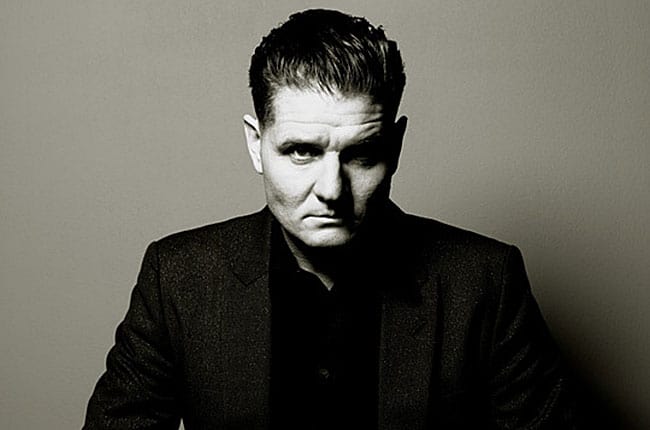
Though Azam Ali is known for her work across many projects, it’s in her solo material that her truest creative vision comes through. Her new album Synesthesia (COP International) continues that trajectory. Self-produced, the record expands her interest in music as a multisensory form and builds on ideas she first began exploring on her 2019 album Phantoms.
Starting work on Synesthesia during the pandemic, without a release date in mind, gave Ali the freedom to revisit and refine ideas more deeply than usual. The album represents an amalgamation of her many talents, pairing her haunting vocals with creative arrangements and soundscapes that blend elements of world music with dark, industrial-influenced electronics.
Born in Iran, raised in India, and now based in Los Angeles, Ali has never separated her art from the cultural or political realities around her. That honesty also informs the emotional core of Synesthesia. Known for Niyaz and her broad soundtrack work, she uses her solo music to explore a more intimate space where her creative personas meet. With Synesthesia, she returns to that inner world and crafts one of her most immersive and multi-layered albums yet.
Over Zoom, Ali discussed the making of Synesthesia.
Are there any major ways that the process or concepts behind this album differed compared to Phantoms?
Azam Ali: I think in many ways it is a follow-up to Phantoms, just sort of expanding on it. But of course, concept-wise it’s different. The reason it took so many years is I wrote it during the pandemic. It started with “Nothing But Time.” That was the first song I wrote during the pandemic, and then it just took a really, really long time to come together. I lost a lot of motivation. I think, like many people, I also went into a depression. It has never taken me this long to do an album. I think more than anything, the pandemic had a lot to do with it. It’s a big part of this album.
And in terms of its concept, it’s just expanding on this idea for me that music is very much a multisensory experience. It’s not just something that’s audible. We can feel it. We can see it sometimes in colors and rich imagery. I myself have that when I listen to music, and I wanted to create an album that would blur the boundaries of the senses.
Did the long timeframe lead to the album evolving more over the course of making it?
Azam Ali: I think it became more mature because I wrote the songs and then I had other projects I had to focus on. And then when I came back, I felt that they could sound a bit more mature and I could make the sounds more sophisticated. So it was actually a very good learning curve also for me. I learn from every album — every project I work on actually ends up being very educational for me. I inevitably learn new tools and my craft gets more refined.
And on this one, I had the luxury of time because I wasn’t even sure if I was going to put the album out. Honestly, I had no deadline or goal like that in mind. So I just really took my time, and for several of the songs I went back and started from scratch. I knew I had the good bare-bones idea for a song or a melody, but I went back and restarted them. So yes, it was just making it as refined as possible.
Regarding every project being educational for you: what did you learn making this album?
Azam Ali: In terms of the more technical aspects, I think the biggest challenge when you’re doing programming is you’re working so much with MIDI files. So there’s an aspect to it that can almost feel a bit cold. And I’m not a keyboard player… so that part is the most challenging for me — how do I create a MIDI file when I play two or three-finger keyboards? How do I map out a MIDI part, a string line, or anything for that matter? If I’m creating a nice arpeggiator, how do I create that without it sounding like it’s just a machine?
So I feel like I got better at doing that. And in the end, I still brought my friend and amazing keyboard player, Gabriel Vinuela — he’s from Quebec. I flew him out to come for two days, and we just kind of brought each song up. I borrowed a Juno from the eighties, a nice keyboard from a friend, and I just had him play over the songs — the parts I had already written — and just infuse them with a little bit of that human touch that you cannot emulate unless it’s fingers on the keys.
There’s a lot of mood and texture, but also a lot of space as well. With all the possibilities electronic music allows for, do you find it challenging avoiding overload?
Azam Ali: Absolutely. I mean, the hardest part — which I think has taken me years and years, and I don’t think I’m even there yet — I think there’s always room for improvement. Sometimes you bring up sounds and you just like them and want to use them, and you want to incorporate certain elements into your song, but then you’re struggling with too many frequencies occupying the same sonic spectrum.
I think that becomes the biggest challenge of working with electronic music: you have to be really careful not to saturate certain spectrums, because then they just inevitably cancel each other out, and you don’t really hear what’s happening. It becomes so muddy.
And my biggest personal challenge musically is — since I was a child — I’ve had a difficult time with extremely low registers, so bass. I have a hard time actually hearing bass. And especially when you get into that area of the sonic spectrum, my ears are very weak, so I have to almost imagine whether or not I’m in the correct ballpark. So I’ll create something and then have people I trust come and listen and say, “Is it working? Is it not working?” So those are the challenges. I think that’s my biggest challenge working with electronic music.
Otherwise, I love it. I find it so inspiring. It’s having an infinite palette of colors that you can play with.
From a creative standpoint, how do you balance the vocal and instrumental aspects? Do you tend to have the vocal ideas early on?
Azam Ali: For me, all songs begin with a melodic idea for the vocal part, or I’m just playing around in the studio and suddenly come up with a certain progression that I really like, or a certain arpeggiator that I create that I really like. And then I think, “That’s so magical.” I could listen to that simple progression for five minutes, and that becomes the litmus test for me: can I listen to this on its own for five minutes?
If that’s the case, then I take that. The most important aspect is the melodic — one simple melodic structure, a vocal part that is going to fit nicely in there. And then I have to create my kick and basic rhythmic pattern. Once I have my rhythmic pattern, then it’s just about filling it out and making it as lush as possible. But that’s pretty much how all my songs start: the bare-bones skeleton of the beat and the voice and some sort of melodic element.
I’m wondering about the relationship between the music on this album and the other work you’ve been doing. For example, what do you get from your solo work that you maybe don’t get creatively from other outlets? Do they influence each other?
Azam Ali: Well, I have so many. That’s why I named my last album Phantoms, because it’s not really about ghosts — it’s about all the personas that live within us that we can move through. Everybody has that. We all have these multiple personas that we learn throughout our lifetime to move through effortlessly. And for me, those are phantoms that live within us.
Since I primarily work in the world music realm, I have this group Niyaz that is a world electronic project, and it takes a large part of my life. And then my film and TV work is largely around ethnic vocalizing and styles of music that I contribute. So after a certain while, I need an outlet to express this different aspect of myself.
When I moved here from India in 1985, I first really got into industrial music, and then that opened me up… and then I started listening to a lot of synthwave. And then I got into industrial music — I was mostly into the music coming out of Chicago and the label Wax Trax! I was obsessed with that music. And then I got really into 4AD, and eventually Massive Attack, Portishead, all those kinds of groups.
So this is a big part of the influence for Phantoms and also for Synesthesia. I would say all the music of Massive Attack, Portishead — those sounds that I got so into. And there are a lot of eighties elements, if you listen closely, in my music. So I need to express that aspect of myself because it doesn’t really come out in the world music projects that I work on, and it gives me a balance.
Could you talk about the covers you did for this album? How did you choose those, and what was your approach?
Azam Ali: I’m very careful about doing cover songs because I’ll inevitably choose something that I really love. And then there’s the challenge of how do I take this song that means so much to me and make it my own? I think a good cover is one where you maintain the integrity of the original song and then find a way to infuse your own spirit into it and your own honest expression.
So my approach to cover songs is always from a place of reverence. It’s not that I believe I can make the song better — because there’s never “better.” You can just do it differently. I usually have at least one cover because I feel like it puts something on a map of something that has influenced me. It’s a nod to an artist who has played a part in me becoming the artist I am.
On this album, I chose “Song to the Siren” from This Mortal Coil, which was sung by Elizabeth Fraser. Her particular version — even though there are so many covers of “Song to the Siren” — hers in particular had a huge impact on me when I was a teenager. Her vocalizing in Cocteau Twins… she is, for me, the most otherworldly singer. And her choice of melodic interpretation is something so uniquely hers — something you cannot write or comprehend. It just comes through her. It’s something magical. And that song comforted me so much in my teenage years when I was very depressed. So yes, it came from a place of reverence.
The second song I covered on this album is actually by Natalie Merchant, and it’s called “This House on Fire.” When this song came out, first of all, it had this gorgeous Middle Eastern string section in it, so of course that part intrigued me — how well she was able to blend her songwriting with a Middle Eastern orchestra. But beyond that, I felt the lyrics were extremely powerful and timeless. And I felt they related to where we are now in America politically, and even globally, I feel those lyrics are so, so relevant.
That song deserved another rebirth. I wanted to honor what she wrote, which I felt was very timeless, and I felt this song needed to be heard again during this time.
Could you talk about the guest musicians you worked with on the album?
Azam Ali: Yes. Actually, not many. As I said, at the end of the album, before I went into mixing, I brought my friend Gabriel Vinuela, who is an electronic musician and keyboard/piano player. He lives in Quebec. He came out and played on some of the songs. He added keyboard — just live — to the parts. He brought some of my parts to life.
And then my husband and musical partner in Niyaz, Loga Ramin Torkian, played the GuitarViol, which is a bowed electric guitar. And he also played electric guitar on a few of the songs. And then on one of the songs is actually our son, Iman Ali Torkian, who played cello. So those were the guest musicians on this album.
Do you perform live with your solo material?
Azam Ali: Yes, I do. But I don’t do many shows because my main focus is with Niyaz and we have a very big stage production, and that’s where a lot of my energy goes. But for this album, most likely I’ll do what I did for Phantoms, which is just a handful of shows in key cities where I have a good fan base, because it would be nice to hear this music come to life. So yes, I do plan on doing some shows for it, but that will most likely be in January or February.
Is there anything else coming up that you’d like to mention?
Azam Ali: Well, we’re actually just finishing the next Niyaz album. We haven’t done an album in a long time. We are one song away from it being completed, and we are working on a huge new stage production. It’s another multimedia stage production, but this time it’s incorporating a lot of the latest technology, and that’s going to be pretty amazing.
That is going to debut in March of 2026. The debut performance is going to be in Chicago. We have a residency there for a week, and then we’re debuting it there. And if all goes well and everything works, then hopefully we’ll be ready to take it around the world.
Purchase the album at azamali.bandcamp.com. For more info on Azam Ali, visit azamali.com.