

Martin Bisi has been a fixture in New York’s independent and experimental music world since the early 1980s. As a producer and engineer, he has worked with artists including Brian Eno, Sonic Youth, Swans, Herbie Hancock, Lydia Lunch and John Zorn. At the same time, he has continued making and performing his own music, much of it centered around the Brooklyn studio he has operated since 1981.
His latest solo album, Dancing On The Power Lines, took shape in a way Bisi hadn’t initially planned. The starting point was a series of guitar loops he put together for Berlin-based drummer Oliver Rivera Drew, without fully formed songs in mind. As Bisi began working with the resulting recordings, the possibilities of the material became clearer. Synths entered the picture, Diego Ferri and Joan Hacker contributed to the sessions, and poet Nora Almeida provided lyrics for many of the album’s songs.
The finished album has a synth-driven, trance-like atmosphere grounded by the energy of live drums. Bisi left room for the unexpected throughout the process, from first-take vocals to drum parts that don’t necessarily return where a listener might expect them. That same openness carries over to performing the material live, where the songs can change depending on the musicians, the room and the audience.
In the following interview, Bisi talks about how Dancing On The Power Lines came together, working with his collaborators, keeping a sense of spontaneity through the editing and production process, and adapting the songs for live performance. He also discusses the 45th anniversary of his Brooklyn studio and an upcoming documentary short examining the studio and the effects of gentrification on New York’s creative community.
What made you decide the time was right for another solo album?
Martin Bisi: Well, the albums come when they come. I usually think I’d like to get a full-length out every couple years. I also think EPs have a lot of value simply because they’re smaller ideas. So usually my EPs, and I’ve done a few, are kind of oddballs. They’re funny. I have a couple of funny EPs. The things I just don’t want to make feel like oeuvres or big statements. I mean, I can create a lot of things, and sometimes when the stuff is, I think, worthy, but it’s not my big vision, I like putting it into an EP. I actually like the lesser format.
So anyway, the record sort of surprisingly came together, and I realized, I felt like the coincidence of the record potentially being out in the same year as the 45-year anniversary of the studio was significant.
In a way, I feel this whole year has a bit of extra mojo. There’s something about this year being the 45th year of the studio. It’s like a special year. It’s a good, important year for me. It’s also a year I’ve turned 65 in, so it’s funny. It’s actually kind of amusing, 65 and 45, which, if you do the math, shows you how long ago I moved to the studio. So I started the studio with Eno, because that’s usually the date that I use in calculating the 45 years, as the first sessions with Eno were in January of ’81. I was 19.
But yeah, I was also surprised that the record really felt like something worthy of my making it a full album. Like I said, feeling like, “Okay, I’m putting all my being into this,” because the process was so unusual. It was basically Oliver from Berlin. He’s in my Berlin band, Oliver Rivera Drew. He was just, “I’m going to be in town.” This was two years ago. “I’ll be in town. Maybe we should just play some stuff.”
I didn’t really have performed songs, so I just created guitar loops, like a dozen or more, maybe 15, that he could just play over. And then it was just a weird process. He didn’t even play songs. He would maybe play on each loop for half an hour, twice. So maybe in the course of an hour and a half, he would just play everything he could imagine, just exploring rhythms, and that was it. Before him going back to Berlin, we did a little bit of some rough edits, like, “Oh, I like this beat. I don’t like that beat.”
So it was really about the rhythm, which ended up strangely being a big component, I think, of this record. What’s this record about? One of the things I think, sonically, is it’s about energy. I think, for instance, my previous record, “Feral Myths,” was drama and emotional drama. And this one was more about energy, particularly the opening track, “Dancing On The Power Lines.”
So that was weird. There weren’t even songs. But that informed what later happened because all I had was guitar loops. And so it’s just a repetitive part over and over again.
And then what was I going to do? Add more guitar? So that’s why I added synth, which is completely unusual for me, to play synthesizer almost on the whole thing. I mean, there’s a couple of spots where there’s some extra guitar, when I would go back and think, “Okay, maybe there could be a little extra guitar.” But I started loving this lean towards synth because I’d never done it before.
I also found it quite fascinating to have this sort of trance electro vibe from the drum playing, but it not being electronic beat-based music. So I liked it sort of being this weird splitting the baby on that, where it kind of felt… And it’s probably also because these were guitar loops, totally repetitive, one tempo. So there was something about the driving force of just a repetitive guitar loop that gave the drumming, whatever was going to happen, a certain kind of drive.
And then it was just endless because then I ran out of lyrics. I ran out of words. I was like, “Wow.” I always knew that was my weak spot. And luckily, speaking to a local poet in Brooklyn, in my neighborhood, Gowanus, she told me about some of her pieces. I’m like, “Wow, that sounds like it could be a song.” She had some crazy thing, and I’m like, “Oh, wow, here we go.” And so that was Nora Almeida, by the way. So that’s half the songs.
Also, that was weird for me, but also sort of revelatory, just printing out the lyrics before I would sing. Of course, I rearranged the lyrics. For instance, “A Slow Drumbeat is a Heartbeat.” That was one line, and yet I made it a repetitive phrase. So there’s a bunch of those things. “Dancing On The Power Lines” was just one phrase in a poem. And I’m like, “That could be repeated. That’s kind of like a chorus almost.” So yes, of course I tweaked that kind of stuff.
But it’s funny because when I printed out the lyrics, I was like, “Wow, this is good stuff.” The difference between staring at lyrics, at words made by a writer, because this person’s a writer. So I was staring at this like, “Wow, I’m working with good stuff.” Because I’m not like some of these consummate lyricists, like Iggy Pop, for instance, continuously writing.
I’ve noticed in the studio, people that are really solid lyricists, that’s how they spend their time. They’re constantly writing. So I’m not that. It’s not a practice of mine. So that was interesting. Also, I didn’t feel like it lessened my statement. I started being proud of working with a lyricist. In fact, people I know, you could say, might’ve almost been relieved. It sounded, “Wow, I’m getting serious.” It actually made it like, “This is an important record.”
I’m also a record producer. So to me, to take a wide view and back up and try to be objective about what I’m doing, it’s not just self-expression. It’s putting something together.
That’s a bit of a thing in the record, which I’m actually glad of. It’s not just me in a band or me with a band. It’s something that’s like a vision that’s constructed, and it’s different elements, different collaborators. And that’s why I’m trying to mention the collaborators, because it’s really quite collaborative, and there I am sticking my name on it.
Usually when I play in New York, or pretty much anywhere, I usually call it either Martin Bisi band, lowercase on purpose, because I hate that vibe of Rollins Band or something. So I’ll go Martin Bisi band, lowercase. Or if it’s something more improvised… because sometimes… I mean, “band,” where I do songs, is usually my preference. But sometimes I want to play, I want to do a show I’ve been invited to, something I want to do, but I can’t. So I’ll do a “collective,” which is kind of interesting because it’ll be kind of cobbled together with people I know around.
So sometimes when I travel, if I’m doing the “collective” in some unusual place and I can’t bring the “band,” it’s kind of interesting because it’ll either be people I meet or people I know already, and then we improvise and have a little fun. So the broader Martin Bisi collective is really a lot of people at this point, several dozen.
So that’s kind of just an exciting process that I also do out of convenience or necessity, where it’s like, “Oh, I can’t bring the whole band. All right, well, what can I do anyway?” So yeah, that’s a little bit of how I work.
I’m curious to hear more about the process, at least in the early phases of making the album. You talked about starting off with a lot of recordings of guitar loops. Was it a challenge editing and figuring out what you wanted to use? At what point do you feel the shape started to come together?
Martin Bisi: Yeah, the editing process was difficult because I think for each song I had two hours’ worth of drum beats. So it is funny that most of those songs have two loops. That’s funny because when I was preparing the songs for live playing, I had to remind people that some of the extra stuff on top and the drum beats make it seem like there’s more going on. Some of those songs, like “Cubesmart Sunset,” two loops. There’s just two sections, really, if you look at the guitar. “Dancing On The Power Lines,” strange. It sounds like a complicated structure. It’s two parts.
So trying to make something work largely revolving around drums that were played independently was very difficult. Plus, I was loving a lot of things. So, for instance, on “Dancing On The Power Lines,” you’ll notice that it starts with this double-time drum part. That’s it for the song. It never comes back, even though the section seems to sort of come back.
So all that gets pretty complicated. Well, also because it passed this point of, that’s why it started sounding almost trancey, almost like what you might see in beat-based music, where the structure isn’t completely outlined like you have with ’90s indie rock, with grunge. Grunge, the structure’s super outlined. That’s the freaking chorus. Massive drum fill going into the chorus, and suddenly it explodes dynamically. There’s very little of that on the record.
But yeah, the editing was super difficult. Also, some of the synth happened after I had the words.
And then after I had the words and the mood, I realized it just needed more because I would have words, drums, and these guitar loops. So then once I had the words, of course, that made me feel like I needed to outline things because the words would do something, and it felt a little boring, just the guitar continuing to do the same thing. So that’s why I had to lift things up with synth.
Also, it’s very simple. You can pretty much hear, now that I’ve mentioned it, that there are parts where the synth fills out, there’s maybe two, maybe even three synth parts, and the guitar loop just goes down. And then the parts where it’s like, okay, enough of that, and boom, the guitar goes up.
Also, another oddity was, and that’s why the synth thing is… I have a friend who’s part of the Martin Bisi collective and occasional band who lives in Gent, Belgium. Her name is Joan Hacker. And it was funny because I sent her this stuff, and it was just drums. And she really loves that drummer in Berlin. She’s played with him. So I thought, okay, cool. “See what you can do.”
When I said, “See what you can do,” I thought it was going to be synth. And then she throws back some singing. So there is some of her singing on the record, even on a song where she didn’t write the lyrics. On “Dancing On The Power Lines,” there’s a break in the middle with this very gentle voice that says, “Sparrow Dive.” That was the original title of the song before I completely filled it out. So she sings “Sparrow Dive” twice in the whole song.
So there are these vocals by Joan sprinkled throughout, and she just had such an almost, to me, comically contrasting voice to mine, because I was trying to do the whole record to sound a little cranky.
I was literally trying to sound like middle-aged, pissed off. I live in Brooklyn. I eat hot dogs. I was trying to slightly come off that way, like a curmudgeon. That was the tone. I would have some cranky voice a little bit. And her voice is sweet, gentle, ethereal. So it’s excellent for what I need with a couple of the songs, like “Off The Cliff.” It’s like a co-lead.
So it’s funny because she didn’t kick back any synth, which is what I was hoping. So then I just put that out of my mind. And then, in a way, that did factor into later adding synth because I realized it had been in the back of my mind.
But not because I really heard synth. It was about the collaboration. I thought my friend Joan, because she loves the drummer and she’s also very techno-oriented, she’s into hardcore techno. So I thought, oh, that’s perfect, since I’m seeing this angle here with the rhythms, yet someone that understands what I’m doing but is coming from a more techno place. So maybe she could add some electronic sounds.
And then she didn’t. She just sang over it and made up words. And then I used most of it. But yeah, then I came back to, “Let me think again about the synth thing.” And then that also contributed to my adding synth.

The album definitely has a very kind of spontaneous, natural feel to it. As you’re doing the production and the editing, are you conscious of trying to keep that atmosphere? Do you think it just comes naturally based on your extensive experience? Could you talk about that?
Martin Bisi: Yeah, the spontaneity speaks to, I think, how unusual the record is. And I realized pretty quickly that it was hard to define. Was it electronic music? Was it indie rock? It was all these things. It’s played live.
I will say that I was very into making sure that the drums sounded like real drums. So that was absolutely essential. Even production-wise, I wanted to make sure that stayed there. Also with vocals, very importantly, it’s a lot of first takes on my part because I realized it’s almost like if you’re trying to act, because occasionally I act in things. People ask me, and I don’t feel I’m very good. And the difference between me and a professional actor is I can just do it once. If I nail it once and they say, “Okay, now do it again and do it a little faster,” it’s really hard. So I’m bad that way. But I often realized that if I want the vocals to sound really spontaneous, I should be ready to commit to the first take.
I can try again, but sometimes, I mean, historically, I remember one time there was too heavy a Brooklyn accent. I’m like, “What the fuck?” Because sometimes when I get a little agitated, I start sounding like I’m from Coney Island, Brooklyn, from outer-borough Brooklyn. I’m like, “What the fuck?” And there’s a lot of “Fuhgeddaboudit” and stuff like that. And so I’ve tried to de-Brooklynize my take. Doesn’t work. I guess, you know what? I’m just stuck with that.
So even on “Dancing On The Power Lines,” on the album, there’s attitude in the vocals in spots, which I didn’t correct. And sometimes they still rub me slightly the wrong way, but I kind of realize it’s real. I mean, that’s for sure. And I want that to be communicated.
I mean, there’s a lot of people, I think, in production in the studio right now, there’s a big trend towards that, I’m noticing. So I think we’re all a little bit on that same page. Also with AI, we’re faced with manufactured music that can just steal big-picture ideas. And people are very into being as unique, as individual as possible, as unreplicatable by AI as possible, as much as possible that it doesn’t sound like there was a computer involved. I mean, give or take.
But there’s a lot of people saying, “We want to sound live,” as you called it, maybe spontaneous. So I think we’re all a little bit on the same page here. And I definitely wanted to keep that.
Also on the record, it’s not structurally perfect. I was part of that. I was part of this very logical structuring of the ’90s. I was one of those producers. I thought that robust structures, bam, here’s the chorus. The chorus explodes. Bold dynamics. Then boom, it drops to the verse or the bridge. Everything goes away and it’s just bass and drums, almost like Nirvana does with “Teen Spirit.” It’s always part of that, these really muscular structures.
And that’s not really there on this. That’s part of the spontaneity because those muscular structures really have to be intentional. They’re kind of manufactured. And in a way, I mean, I still think they’re exciting. I like ’90s-style productions, but no one’s impressed anymore by robust. They want vibe. People want vibe and realness.
The album also has a very cohesive feel to it. Was there ever any point where it might’ve veered off? Was there material that maybe didn’t make it on because it didn’t fit in?
Martin Bisi: Well, the one thing that almost didn’t make it on was the closing track, which is “Anarcho Nihilist: The Final Communication.” So that was almost a demo for myself. I played the drums. It’s like a floor tom and a snare. I mean, Oliver in Berlin added some percussion just to tie things together. Diego Ferri, who plays either baritone guitar on the rest of the record or bass, added some synth. So they contributed stuff, but basically that was one, or at least the foundation, I’d made by myself. And it was an afterthought to even put on the record. And it was one of these things, a bit utilitarian. I thought eight songs was a good target.
I really wanted the statement of a full LP album with full sides. It was actually going to be a bit too short, the running time. So that was kind of important to me. I realized I recognized the statement of the record. So it was a little bit of a throwaway or afterthought to put that on there.
But then I weaved it in a little bit because it’s the final communication. It’s a sort of communication from an imaginary end of global civilization imposed by climate change. So I’m zooming forward maybe two centuries, and there’s an “Anarcho Nihilist” announcing to the world that it’s all over and we need to move on to something completely imaginary, maybe more spiritual even, if you will. Like the end of time, this kind of stuff I sing about in that song. I thought it was kind of funny. In a way, when I try to explain the song to people, I say, “You don’t want that guy.”
If we don’t course correct, that’s the guy you’re going to get. So we can laugh at it now, but you might not actually want that.
I’ve also now, as much as that was a bit of a throwaway and almost didn’t make the album, I also now end my live sets with that. I actually stand in front, put the guitar down, hold up a clipboard like I’m making an announcement to Rome or something, and I basically make that whole declaration. So now it ended up being important as a sort of epilogue.
And the one I put before that, which is “The Last Conquest,” leads to the final communication. “The Last Conquest,” basically, it’s about, it references Christopher Columbus’s time in Jamaica when he predicted the lunar eclipse and he manipulated that to get some extra supplies from the inhabitants.
So that’s why the word “blood moon” kind of happens throughout. So that was a bit of a metaphor for the catastrophe that happened in the Americas after 1492. So I call that “The Last Conquest.” And weirdly enough, what I’m implying is that that crime against the planet, which was what happened in the Americas, the destruction of its ecosystem and its peoples, that there was another one coming. And then the next one, maybe more climate-driven or whatever, then that’s it. We have one more chance to do some abhorrent thing to the world. And if we do, then it’s pretty much over. The jury will be in.
So I juxtaposed those two things. Anyway, what’s funny is I really thought it was a throwaway. And some people are like, “That’s my favorite one.” When I was talking to Ego Sensation, who, by the way, is in the band White Hills, and she helped with the music video, I was like, “Which song would you like to do?” She goes, “Maybe ‘Anarcho Nihilist.'” So it’s a lot of people’s favorite song, or it’s their second favorite.
So it also shows the thing that happens to everyone all the freaking time. There’s a thing that they don’t think should make the album. That’s why I’m always suspicious of people cutting a song on an album as a producer. It’s very comical. So I’m like, “Well, let’s zero in. Let’s focus on what this album’s really about.” All that stuff, putting our best foot forward or really now, with a bit of an overview, nailing the concept. So I’m always uncomfortable with people cutting songs.
Actually, there’s two. Another reason is I really dislike, and that’s why I think some of my material tends to get very dense and all that, I dislike throwing away work. It’s just like, you put energy into it, I think it needs to live somewhere. So that’s a bit of an ethic. Maybe I’m illogical about it, actually.
But yeah, so all that sort of informs the record. Also, my attitude of not throwing away anything. That’s why there’s so many different drum parts in every song. “That’s a good drumbeat. If that drumbeat is inspired, maybe it should live somewhere. Okay, maybe it’s a break. I don’t know.” So I like using everything.
Given the process of making the album, was it a challenge at all adapting the music to perform live?
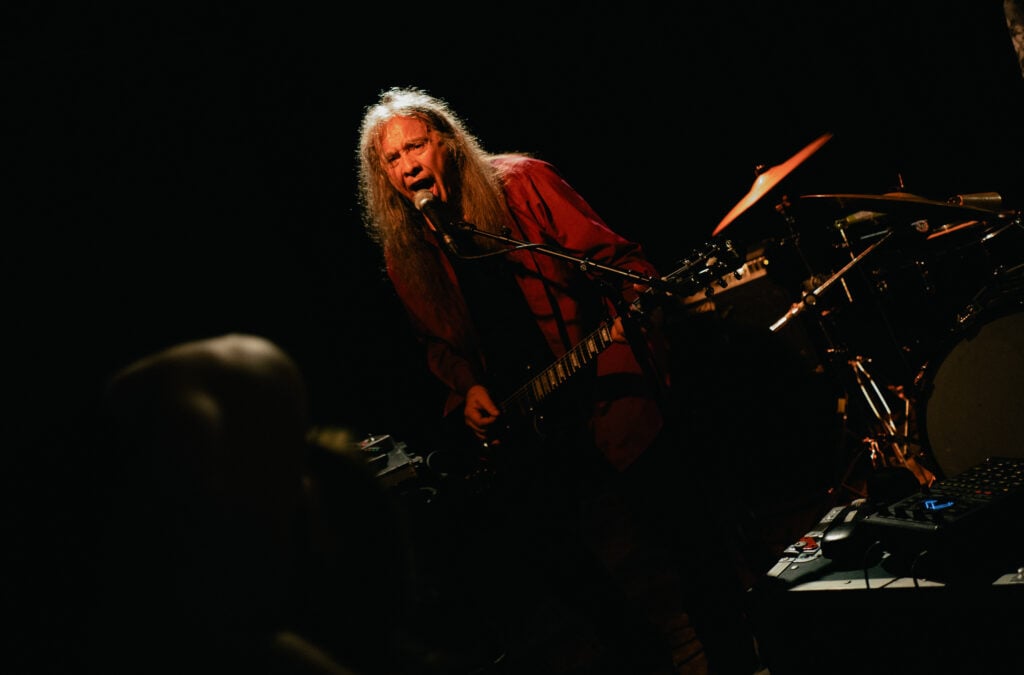
Martin Bisi: That was scary. So much has to do with the drummer. One thing that shocked me… Well, I basically do three songs from the album in the recent shows. So I end basically with “Anarcho Nihilist,” with the band sort of improvising the background. And in the middle, I do a proper take of the two opening songs.
So, for instance, with “Cubesmart Sunset,” I was a little shocked. It had a lot to do with the drummer. How is it possible? I thought that was the moody, vibey, laid-back tune, and it kind of sounds like hardcore with roughly the same tempo. How is that possible? I don’t know. It just kind of sounds more rock and roll than I thought, unusually so, but an unusual kind of rock and roll. Not terribly old-school, but still almost like hardcore, metally. I don’t know how that happened.
And then “Dancing On The Power Lines” also, I mean, thankfully I just let the drummer, Dave Miller from my New York City band, I let him kind of do it. So basically, I know because both of those songs have two guitar parts, so I know what I’m doing. The bass player is Vern Woodhead here in New York. So they actually did the work of structuring, of making it feel like it’s not just two guitar loops.
And as is usually the way I am, for a lot of reasons, I sort of like horizontal collaboration. I don’t like telling people what to do. So I just let them do what they’re going to do. So they crafted them, really, because I already had my two guitar loops. I just played them over and over again.
And then even what I did vocally, or how I delivered the same lines, is sort of informed by how the band is sounding. So live, there’s a few moments vocally where I try to do it like I did on the album, but also a little different. Is it more screamy? Is it more projected? Is it mellow?
During my live sets, I can spontaneously add long echoes on stuff. That’s kind of important. So I don’t let the sound person do it. I don’t like echoes through the whole thing. I just like being selective. So bits where I hold long notes out, I add echoes, this sort of thing.
So that sort of stuff is also done spontaneously, really relative to what other people in the ensemble are doing. So, for instance, I did two shows with a synth player I like working with in New York, Genevieve Fernworthy. So that synth, that was cool. And the other show, it had to be someone else playing this Chapman Stick, not synth. So that was completely different.
Also, it’s funny with vocals, the thing that I discovered years and years ago, which made it possible to never have a bad show. Since this discovery, I never had a bum set. And the trick was leaving it open to how I sing. So I actually discuss it with the band. Maybe I’ll come in later. Who knows? If shit’s really percolating, or if I see people dancing or moving in the audience, maybe I won’t come in right away on the vocals. So it’ll be more extended. If that happens, you can do more.
Maybe it won’t happen. Maybe I’ll sing it low. Maybe I’ll sing it high. Maybe I’ll scream this part. Maybe I won’t scream this part. All kinds of stuff. Maybe I feel like everything’s getting a little sleepy. I’ll scream more. Maybe I feel like I’m bludgeoning people with screaming. Maybe I’ll do a little less, depending on how the room sounds.
As soon as I could adjust on the fly what I was doing vocally, I could always adjust to any situation. So even if the set feels like it’s going south a bit, in other words, not great, I can lift it up by doing vocals a little differently, maybe even playing less guitar. So always, always spontaneous. Too much of a cookie-cutter set has never seemed the best strategy for a good set.
Is there anything else you’d like to add?
Martin Bisi: There’s a documentary short coming. It’ll be this fall. They don’t know the title yet. I think that they’re kind of rushing. It’s just a short, so it’ll be like 25 to 30 minutes. It’s not that much work. Everyone’s a little overworked in New York City right now. I mean, everyone’s got four jobs. Very, very unaffordable. But it’s coming in the fall. They don’t have a title yet.
So it’s still, also like me, sometimes you can really tie the bow together once you see the whole thing. It covers the ongoing saga of gentrification in New York City and primarily Brooklyn. It’s nice to remind, because it’s interesting. It’s a warning to everyone and everything, how New York City and even Brooklyn was a bit of a cultural capital of the world at one point.
I mean, the Lower East Side of Manhattan was a cultural capital. And then you had Williamsburg, so the era of “Meet Me in the Bathroom,” of The Strokes and all that stuff. And that kind of moved into Williamsburg, also an epicenter, post-Seattle, post-grunge, of music and culture in New York City. And that’s been damaged by urban policies and gentrification.
And my studio barely surviving all this. I mean, I’m just lucky I picked this building and there are sympathetic owners, because they’re part of the little islands where the city is hoping that the arts will be maintained. It’s like we’re shoved into little reservations of, “Okay, maybe in this little corner, that building, there could be some arts left and we’ll try to stay out of the way.” So it’s very little.
Well, we had the whole city as our playground for the arts. Now we’re shoved into little corners. So the doc short covers that a little bit, I hope.
Just like with the original documentary, which is “Sound and Chaos,” which is now 13 years old, I’m hoping it doesn’t have my name in the title because I really think that it’s about the place. Plus, it’s miraculous that the same place since 1981 has been here. I don’t even know what that’s a testament to. I think it’s complicated, but it’s still pretty miraculous.
I mean, what other studio has even been here that long? Someone mentioned to me the other day, I guess Electric Lady Studios that Jimi Hendrix started in the ’60s. That still exists, but there’s not a lot.
So anyway, that’s coming. And I don’t know, I dare to say it’s a bit of a celebration of something. I do think it’s a small victory in a way, if I may be so, not to sound arrogant, but I do think it’s a small victory for a certain musical community that appreciates outside-of-the-box thinking and novelty and innovation and a pioneering spirit in the sounds.
For more info, visit martinbisi.com


