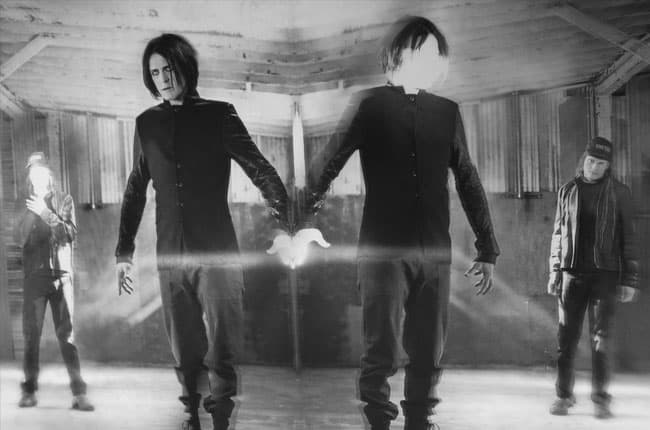
More than a decade in the making, Romagna, Italy–based indie pop rock band The Silver Snails return with their second album, Speed of Light. The album was recorded in Italy and Portland, Oregon, and co-produced by Dylan Magierek (Badman Records).
Anchored by husband-and-wife duo Lucas Ward and Elisa Fantini, The Silver Snails released their debut album, The 7 Melodies, in 2012. It introduced listeners to their mix of multilingual lyrics and melodic, carefully crafted songwriting. With Speed of Light, they have refined that vision into something both timeless and fresh.
Influenced by many artists, from The Beatles and Pink Floyd to The Flaming Lips and Bon Iver, Ward approaches songwriting as a craft, following each idea until it feels complete. The result blends rich harmonies, textured arrangements, and a sense of musical curiosity that runs throughout the record. Among its ten tracks is a vibrant cover of “Video Killed the Radio Star,” reimagined in the group’s family-centered style.
Over Zoom, Ward discussed the making of Speed of Light.
Speed of Light has been a long time in the making. Could you talk about the timeframe and the process behind it?
Lucas Ward: Yeah, it’s a series of factors. We released our first CD, which really launched the project, in 2012. Self-produced, self-marketed, and I spent quite a while trying to get traction with the project, doing showcase concerts. I did some in Italy, some in the US. All of that was recorded in Italy, in a little studio in a little village called Sarsina. The people I had were very good, but I felt that I needed to find people who were closer to the music market.
So around 2014, I basically started looking for a new team in the US, and I went to Portland. I’m from Portland originally. My wife is from Italy, but we live in Italy. I bought a mixtape—I was in a music store, and one of the songs on it was by a band from Portland called Strfkr, a new band. And it was fantastic. It was so good, it just kind of stood out from all the other stuff. So I decided to find the guy that made it. I tracked down the producer, who’s a local guy in Portland named Dylan Magierek.
From that point on, we started working on the second album, and I was going back and forth. That took time. I would go to Portland and record. One of the key things was that I’d set this kind of almost impossibly high bar in my mind. I wanted to make the greatest record that had ever been made—or certainly the greatest record I could. And so that mindset meant a lot of delay, like remixing things with different mixers. I did that a couple of times. On one song, we did the drums with three different drummers.
After some years in Portland recording, basically we ran into COVID, and I hit a really rough patch financially. I had to divert all of my energy to working to make money. So it went dormant for a few years, and then I got a gift from someone close to me to finish the record with a deadline. We finished it, and then it took another few years to get the marketing together. So it’s really a function of when you’re an independent musician, you have to do everything yourself, you have to come up with the funds, and we have a family as well.
And then if you’re trying to do stuff that’s really top quality… I mean, anybody can crank out a record in a week if they need to or want to. But my hypothesis about the music market—well, one of them—is that there’s just so much of it that the only thing that matters is quality. The only thing that can get someone to listen a second time or share it with a friend is that it’s really got to be quality. And I think there is such a thing as quality. Some people will debate whether there’s really good and bad in music, but I think when you take a stand as a creator to make music and say, you guys should listen to this stuff, you’re essentially saying, not only do I have skill, but I also have taste. And that may be an illusion, but I think all artists spend a lot of time thinking about what they think is good and what they want to exclude.
To me, it’s things like: when you write a song, it’s kind of a process, and you keep following and following until it’s done. So it’s the willingness to go all the way. And then the same thing with the arrangement, the same thing with the recording, the same thing with the mixing, the same thing with the mastering, and the marketing, and all of that. So we want to bring something that’s differentiated by outstanding quality, that’s original, artisan if you will—somewhat old school in terms of the way it’s made—but ultimately just fresh and listenable, and that communicates some kind of energy or feeling that helps people.
How might it have evolved over that time? Are there particular songs that you were actually working on for all those years? Was there material that you discarded? I’m curious, in terms of what we hear in the final release, how it fits into the time span.
Lucas Ward: So there are nine originals and one cover, and two of the originals I started writing right after we released The 7 Melodies. We actually recorded them in Italy but ended up remixing them in the US so that they’d be more homogenous with the rest of the record.
For me, the writing process is like songs coming in as little seeds, little ideas—like a chord change. “This chord change is kind of cool, maybe I’ll develop that.” And then, “Oh, I kind of hear a melody.” It’s almost like: do you want to pull on that string? Do you want to follow that seed all the way to completion? It’s really exciting to get a new idea when it first comes in. So I usually try to capture it with a voice memo. Then I end up with a whole bunch of little kernels. Some of them I remember, and there’s just this sense that there’s something more substantial there.
So then I’ll decide, “Okay, this one here is slated for full development.” And then I go through that process, which is many steps—writing, arranging, and developing. I did almost all of that work in that period. In other words, I was focusing on one record at a time. With The 7 Melodies it was just unbelievable, the stuff that we went through for that one, including full videos shot on location at night and at the beach, and turning our house into a movie set, and all that. And of course, we continued with our “Video Killed the Radio Star” video on the second album
So when I was working on this album the whole time, I was thinking the same thing: This is album number two. It’s got to be as good as I can make it. I need to do what it takes. I’m not going to worry about how long it takes. So there was just sort of this obsession with the record. And I guess it’s worth it if you think, “Is it better to have four albums in 12 years or one really, really good one?” Again, I really value quality over quantity in music.
It didn’t really bother me, except that it was frustrating to not be able to get to the finish line. But I didn’t mind the fact that we were taking a long time to do one record. I don’t see any particular time limit. There’s no right answer to how long a record should take. All that matters is how good it is.
Your music seems to combine a lot of different styles and influences. To what degree do you think it’s just organically coming from the music you like versus intentionally trying to work with particular styles or ideas?
Lucas Ward: Yeah, so I love all kinds of music, and I’ve studied all kinds of music, and I’ve studied lots of different instruments, and I’ve traveled the world. But when I really decided to focus on being a singer-songwriter, I made a list of what I call magic songs—the songs that have the most energy for me or the most effect. And I started transcribing them, in some cases note for note.
So I would take “Yoshimi Battles the Pink Robots” by The Flaming Lips and transcribe it. In some cases, we did full covers—we have songs in reserve that are studio versions that are very accurate. So it’s kind of like a reverse-engineering process, the way painters work: they start by recreating the works of a master to understand what the technology or the technique is behind it.
I spent about seven years before I even launched The Silver Snails just woodshedding music, transcribing, learning new instruments—and I’d been playing music formally since age eight or so. So for me, it is very explicit. Music has a really strong effect on me. If something is really happening, then I want to understand what’s behind it. And it doesn’t mean I’ll write down the whole song with pencil—maybe I’ll just take one part, like “That bass part is really cool”—so then I’ll transcribe the bass.
I think almost everybody learns this way, even if it isn’t as calculating—where you’re writing stuff down—but maybe you’re just learning covers, playing songs by people you like. With all art, whether it’s music or sculpture or writing, we’re all links in a chain. We absorb the influences, and then our minds are organic synthesizers that combine those elements spontaneously. I don’t believe that any music you or I would want to listen to is created in a vacuum. It’s all channeling, invoking, and recruiting the musical language from the stuff we love. And if you do that deliberately, then you’re able to do it even better. You’re able to express yourself better because you’ve deliberately acquired the tools to communicate the way the greats have.
Could you talk a bit more about working with Dylan and what he brought to the project?
Lucas Ward: Well, I mean, it’s become a friendship. We’ve spent a lot of time together. When I’m in Portland, I see him and I consult with him frequently. Dylan is really great to work with—a good producer—but you can find good producers and recording studios pretty much anywhere.
What I got from Dylan that I think is really hard to find is that he also has his own record label, and he makes a living from it. He’s a rare bird: a solo, independent record label that actually sustains itself. And what that means is that he has deep knowledge of music marketing. In the indie world, it’s very guerrilla. A lot of initiatives are very small—you make one submission on SubmitHub for $5 and hope the person on the other end plays your song. But it’s not very scalable. And you have to know people. And I probably spent as much time trying to learn at Dylan’s feet the art of music marketing as I did recording. Because again, as an independent, it’s on us. And what’s the point of making the world’s finest pop rock if nobody hears it?
That’s kind of the demon that’s haunted me the whole time: how do I scale the marketing part? I’m still working on that, but Dylan is my strongest asset, both in terms of knowledge and contacts on that side of things.
In terms of working in the studio, it was just fun. He’s a great, empathetic, low-key producer who has worked with popular acts like Strfkr and My Morning Jacket. He’s creative, he’s a musician, and he’d add some nice touches. But I think if you’re stretching out over years, it’s not like “Oh, we’ve got three days, that’s all we can afford, and we’ve got to do it as fast as possible.” It wasn’t like that at all. I would go back and forth for years, and we’d have a great time—we’d take walks, eat Vietnamese food, and have long talks. It was very therapeutic.
Prior to this album, you had done an Elliott Smith cover. Could you talk about the inspiration and why that was done as a single and not an album track?
Lucas Ward: Yes, thank you. Elliott Smith is an important part of my musical formation. We became friends when I was a kid. I went to high school in Portland, Oregon, and grew up there, as did he. We met on the first day of French class as freshmen in high school. His birth name was Steven Smith. Even as a freshman in high school, he had already pretty much decided that music was his thing. He would record full albums—he made four of them during high school on four-track, reverse-engineering the music that he thought was cool, from The Beatles to Led Zeppelin to The Smiths to Elvis Costello.
He was doing all that at that point in time, and he had a real gift. When I sat next to him and listened to him demo his stuff on the piano, I was just carried away. I felt this kind of elevation, or euphoria, or magic around it. And I think that’s why, ultimately, without actively trying, he sort of got slotted into the big-artist track—because there was so much natural gift. But he also worked on it so much. Imagine someone from age 12 through 20 or so—that’s all they do, because he didn’t really care about school.
So it was not only being friends with Elliott and seeing him make the leap, but also those early memories of being affected by his music. Later, when I was in a transition where I could choose to do something new—I had basically left my first career, which was in finance—music was at the top of my list, and he was my best kind of model in terms of how I wanted to do it.
And speaking of covers, could you also talk about “Video Killed the Radio Star” and why you chose that song?
Lucas Ward: Okay. So while I was making that record, I also recorded a few covers, mainly for my own interest. Again, I was really interested in figuring out all the parts and reproducing the music that I love. We recorded some Beatles covers, this Elliott cover, and a couple of others which we haven’t released. So I had this thing in reserve. Of course, we had also planned to put a cover on the record, “Video Killed the Radio Star.” It had the video, and I didn’t really have a plan for releasing the cover songs. But Dylan said, “Why don’t you release that Elliott song first? Because it’s Elliott, it might get some attention. That would kind of warm up the market for the new record.” So that’s what we did, and that was the plan.
It’s not like it went viral or anything, but I did get a lot of nice comments from people—others who, like me, love Elliott’s music.
So you asked about “Video Killed the Radio Star.” Again, there’s kind of a thing about covers in the indie music industry. If you go to Italy, it’s almost all cover bands because it’s way too hard to start an original band. There’s still a market to serve—meaning all the little fairs and towns. They’re not going to go see something they’ve never heard of, but if it’s a Pink Floyd cover band, they might. So it’s almost like people are settling for doing covers because it’s impossible to make it as an original.
Now, what I find on the West Coast is that there’s a kind of snobbery about playing covers. It’s like karaoke or something. I actually played in clubs in Portland where covers weren’t allowed. And that was a problem because maybe I didn’t have that much material and I needed to fill out the set. In some cases, I would just play one cover to keep it tasteful.
So that’s the balance we’re striking here. On one hand, we’re using covers as a bridge to new fans, but we don’t want to do it too much—we don’t want people to think we’re a cover band. “Video Killed the Radio Star” was really interesting because it fits our format. We’ve got me, my wife, and my kids—so you’ve got a male tenor lead, and then this kind of chorus, more of a female backup chorus. It’s really fun, and it really works.
From a message standpoint, it’s also just a fascinating song. It’s about how technology drives transitions in media, which ultimately drives transitions in how we relate to media. So it’s a very clever and very relevant message, and kind of unusual, I think, in terms of the songs we normally listen to, that someone would actually be singing about that.
Are you currently actively performing live, and if so, what is your live approach in terms of instrumentation?
Lucas Ward: In terms of the actual show, I hire top-notch performing musicians, just like in the studio. And it’s a rough game for them—they don’t usually get paid that much. Sometimes there’s no budget to even rehearse. So these are guys who can actually go on without rehearsal.
In the case of this latest iteration, I did a mini tour of the Northwest a few years ago, and I was able to get a lot of the same people. So I had the same bass player, drummer, and guitar player, and then we added a keyboard. So it’s basically a five-piece: bass, guitar, drums, keyboard, plus me.
If I’m in Italy, then I have my family. My wife is mostly a backup singer, but she also sings some lead. And then I have a 22-year-old daughter who can sing anything. That’s a real strength. So when I’m in the US, I think of it as a five-piece rock band. And when I’m in Italy, where I have my family available, then it’s more like a family band.
It’s like the rock band plus the family as kind of the front. Like groups of yore—lots of groups like Queen had just one lead singer, and everybody else defaulted to backup. But with The Beatles, they would share the lead, and everybody was doing both lead and backup. So we just do the most we can, depending on the song.
I very much lean on the old-school rock band format, but I’m a stickler for harmonies—for having more vocals. I think that just makes a huge difference in the way it sounds and feels to have at least two voices.
For more info, vist thesilversnails.com.
“Speed of Light” have be purchased as a download here and CD here.