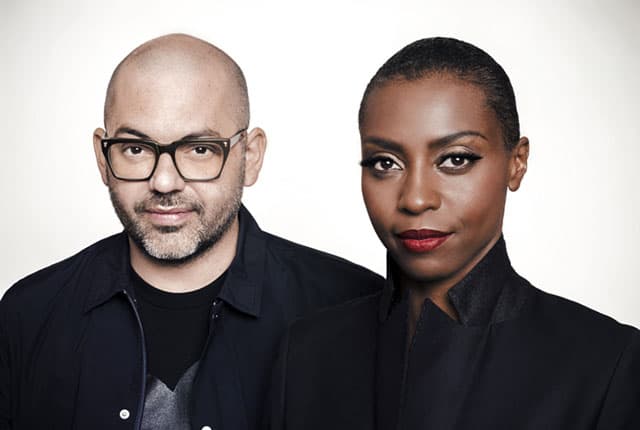
KMFDM have built their career on constant movement, and Enemy captures the band in another phase of that ongoing evolution, with Sascha “Käpt’n K” Konietzko pushing deeper into rhythm guitar and a refreshed lineup shaping the sound. Led by founder Konietzko alongside longtime member Lucia Cifarelli and drummer Andy Selway, the album also features new guitarist Tidor Nieddu bringing his own bold and vivid guitar approach into the mix. Contributions from Annabella Konietzko, the daughter of Sascha and Lucia, continue a generational thread within the band. Enemy balances riff-heavy immediacy with KMFDM’s trademark blend of electronics, aggression, and socially and politically charged commentary. In a Zoom conversation, Konietzko discusses the evolution of Enemy, his approach to songwriting and album flow, working with new and returning collaborators, and why KMFDM continues to treat each release as part of an ongoing creative process.
You recently released a new album, “Enemy.” Were there any major differences in your approach or process compared to your previous album?
Sascha Konietzko: Well, it was pretty much the same process. The one thing that was very different this time is that I actually learned how to play kind of rhythm guitar. So I just played a bunch of guitar and knocked myself out, to my heart’s content. And then I realized I’m okay with rhythm guitar, but I’m not a soloist at all. So then we started looking around for a new guitarist and found a guy from London named Tidor Nieddu, who is a fantastic guitarist and a great human being, and the KMFDM family has been enriched by his participation now.
What inspired you to play more rhythm guitar?
Sascha Konietzko: I just saw this guitar and it was so sexy, and I thought I must have a nice guitar like that.
Did it have a specific impact on your songwriting process?
Sascha Konietzko: Well, I guess because of that, I emphasized the guitar stuff, put it more in the foreground, and made a very riff-heavy kind of album. So that was a little bit different from the last couple of albums, which were more synth driven. Other than that, it just always happens the same kind of way. It basically starts with tinkering around with bits and pieces, notes and audio field recordings, and then I’m just starting to put things together and song kind of structures appear, and then we just pass it around and everybody has whatever input they have. And then in the end, it all lands on my desk and I’ll just put it together and it becomes an album.
Is there a point where you feel that the direction and the sound of an album really comes together and you know where it’s going? Does that tend to vary by album? How was it this time around?
Sascha Konietzko: Well, to me it’s really important that an album has a beginning, a middle, and an end. So pretty soon, once a couple of tracks are emerging from the primordial soup, so to speak, I start thinking about which one would be a good opener, which is a good closer, and this is something that probably goes a little bit contrary to nowadays, as kids, the way they listen to music is more like song. It’s not like an album. I mean, I don’t know any young people that listen to an album really from top to bottom, but for me, that’s a very important part of making an album. It’s like I don’t start to read a book from the end, you know what I’m saying? So call it old fashioned, but that’s the way it kind of works on this end.
Does that affect your choice and ordering of singles at all, given that people might not listen all the way through?
Sascha Konietzko: Well, for the longest time, we have not had any single releases, contrary to way back in the eighties and nineties when we would put out singles and remixes and single remixes and albums and then album remixes. Nowadays, the term single in the classical sense, maybe a seven inch on vinyl, obviously doesn’t really exist anymore. So a single is more like being used to prepare your digital streaming services for an upcoming album. But I think the driving momentum behind choosing which song is being pre-released as a “single,” I think that’s the same. I mean, I was talking to the band and we were contemplating which song would really come best as a first glimpse. And unanimously everybody said it’s going to be “OUBLIETTE” because it just has the immediate catch without laying down the more serious tones of “Enemy,” which was the second pre-release. Yeah, so that’s kind of basically how it goes. I mean, you wouldn’t want to scare people away with the first glimpse of an album.
Tell me more about your new guitarist Tidor Nieddu. How did you come to work with him?
Sascha Konietzko: Well, I mentioned to an old friend of ours, whom we had been touring with almost a decade ago, that I’m looking for a guitarist. And he said, “Oh, I know someone that would totally, totally, totally fit the bill with KMFDM.” And one phone call and the deal was basically sealed. The guy was like, yeah, absolutely. And I really liked him and sent him a track or two, and he just shot me back what he was thinking about it, and that was it. I was like, yeah, this is a match made in heaven.
Your daughter Annabella contributes to this album. Could you talk about that?
Sascha Konietzko: Well, Annabella has been writing her own music on a pretty simple little rig, like a MacBook with GarageBand, a microphone, a little interface, and she’s been doing this for four or five years. And I was always really astonished by how targeted she is in choosing instrumentation and how she constructs songs, which is quite different from the way I do it. And this time around, she came into the studio and I was working on this track and she said, “Oh, I really like this. Just keep playing it.” And I just kept playing it and I dunno, maybe I did my taxes or something. And after half an hour she was like, I got lyrics for it, and I got a melody. So I said, “Okay, let’s turn on a microphone and let’s record it.” Because I firmly believe in first takes. First takes, to me, always transport the real kind of idea of a song.
So yeah, we just started rolling and recorded it and I don’t know, after an hour and a half, we had so many vocal tracks in the box that I was like, “That’s it. This is really it.” Then she said, “Well, we need to rearrange some of the parts,” which we did. And unlike any other song on this album, this thing came together just snap, where oftentimes I’m questioning myself and I’m like, “Could this be a little bit different? Would it be better if it were different?” But her ears and her mind are so fresh and she’s so opinionated that she basically dictated, “This is how it goes.” And I was like, perfect. Finally I found some guidance. Great.
Does she perform live with you?
Sascha Konietzko: She did perform live with us on the last tour in 2024, and I think that really paved the way. She’s very confident. She walks on stage and she looks like she doesn’t give two damns and she just does it and she’s convincing. I mean, she has a quality to her voice and that is inimitable. So I think that’s really great. And one of my oldest fantasies was that KMFDM could, one day, become a band that goes into a second generation.
Maybe the paving stones are laid for that at this point. Who knows? Also, the reception was really, really positive. I mean, I noticed in the past six or so years that our live audience has totally rejuvenated. When in the olden days we would stand in front of people that were pretty much in the mid thirties to early fifties or so, now we have teenage kids in the front rows just screaming their heads off, like we’re the Beatles. It’s like, come on, man, what’s going on? And of course, this part of our audience totally relates to a young girl performing with their favorite band, and I think that’s really great. I think it’s just a really good momentum.
You mentioned sometimes questioning things as you’re working on music. Doing a lot yourself, being a small lineup, and having so many possibilities with digital technology, is it a challenge knowing when something is ready and should not be questioned or tweaked further? Does that present a challenge, and if so, how do you manage that?
Sascha Konietzko: Well, that’s a really tricky thing to determine because obviously when you give yourself endless amounts of time, you tend to fiddle yourself to death. You just keep turning these knobs and moving those faders, just a little more and just a little less and this and that. So the way I counteract it is I give myself a deadline. So about halfway through an album, I’m going to start talking to the label and we’re going to look at a release date and a delivery date. And then putting the thumb screws on really works super great for me because that prevents me from just losing myself in the endless possibilities of digital workstations and this, that, and the other.
And I’ve never been looking to make the one sort of defining album of the career. I always think of KMFDM as like a ‘go and deliver as we go.’ I mean, there’s a huge demand from KMFDM’s fan base. We just did one tour and they say, “Well, when are you guys coming back?” Well, we just put out a record and they go, “When’s the next one coming?” So I look at a KMFDM album more like a screenshot or a snapshot or a series in a photo album of a certain timeframe. So I think the gravity or the pretentiousness that some artists put into their work doesn’t really exist with KMFDM. I mean, we’re very serious about what we’re doing without taking ourselves too seriously. And so yeah, an album maybe may have benefited from, I don’t know, another week tweaking or so, or it may not. So I don’t care. I mean, it sounds great. Let’s put it out.
Is every album pretty much a fresh start? Do you ever have ideas that might have been cast aside that didn’t fit the previous one, and you might utilize in the future? Or do you tend to completely discard things that don’t work?
Sascha Konietzko: No. If it doesn’t work, I throw it out because I hate this going back to bits and pieces and then coming back to something that I worked on four or five years ago. I’m like, what the hell was I thinking? It’s not good. What I do sometimes is conserve a particular sound or something that I liked about something initially, but sort of keeping sketches around is not a good way to work for me.

You’ve had to postpone your European tour. Will that have any type of creative impact? For example, has the delay led you to rethink anything about the set list or other aspects?
Sascha Konietzko: Well, the reason for postponing the tour is because of a serious health issue that needs to be addressed, and we have rescheduled part of the European dates already for the summer of 2026. The remainder of the dates have been scheduled for early ’27, a year from now. So other than that, it doesn’t really have any impact. I mean, it’s very, very sad that our fan base has to wait for a couple more months, and especially seeing that most of the dates were already totally sold out. It would have been a triumphant return to Europe, but it’s not canceled. It’s just postponed.
As an artist who has always embraced technology as a creative tool, I’m curious as to what your thoughts are on AI.
Sascha Konietzko: I mean, I get it, but I don’t get it. It’s like I had a ChatGPT session once last year where I asked ChatGPT to come up with a four bar kind of guitar riff in the stylings of KMFDM, and I was very specific. I said I want it to be in E minor. I want the tempo to be 132 beats per minute, blah, blah, blah. And it said, just wait a moment. And then it asked me which file format I wanted, and I specified that. And then I got a media file with this proposition of a KMFDM guitar which went doot doot doot doot doot doot doot doot DOOT, this all one note. I was like, okay, so much for that.
Then I said, can you make an illustration in the stylings of KMFDM for a potential KMFDM record cover? And it came up with a very strange kind of rendition of something that looked very much like AI and very cliche. And then the bot asked me, what’s with KMFDM? You keep asking me about KMFDM. I said, oh, I am KMFDM. And the bot said, “What a pleasure to talk to you. I’m a huge fan.” I was like, “Fuck off, AI.”
And so I showed this image that it created on our Facebook page and people were like, “Boo, KMFDM is using AI now. This is really horrible.” So much for that.
Every once in a while I see people online talking about the MDFMK album and fans still really, really like it. I’m curious as to your thoughts on that looking back. And I’m wondering, has there ever been any attempt to get the rights back or do a remaster or anything further with it?
Sascha Konietzko: I think MDFMK was just the perfect thing in its time. I don’t believe in going back to things. I always look forward to new horizons, so to speak, and I believe Universal Music has the rights to it in perpetuity anyway. And so the dynamic of the trio that was MDFMK has not existed ever since. And in fact, I have not spoken to Tim Skold for, God knows, fifteen years or so.
I mean, take it for what it was. It was great. And it’s kind of like other side projects that I’ve been involved in in the past. There’s little reason to bring them back. I mean, Excessive Force was one of my projects. That was great, but that was it. And there was KGC with Dean Garcia from Curve, that Lucia was on. And these things all have their right and their place, but I don’t really see why anyone would want to go back to something like that. Then it would be measured and people would say, “Oh, the old MDFMK was so much better than a new MDFMK.” And vice versa. You just open a can of worms. I mean, I’d rather come up with a brand new side project rather than going back to an old one.
Is there anything else you want to add?
Sascha Konietzko: Well, yeah, there’s going to be the KMFDM coffee table book coming out very soon. That’s going to be a really wonderful edition for the KMFDM fan community because for the first time they’re going to have a nice book with every cover art that we’ve ever used, and it’s going to be in a bunch of languages and there’s a lot of background stuff and cool things. So yeah, keep your eyes peeled for that.
For more info on KMFDM, visit kmfdm.net.