There was a time when discovering a film felt like being let in on a secret. SCALA!!! Or, The Incredibly Strange Rise and Fall of the World’s Wildest Cinema and How It Influenced a Mixed-Up Generation of Weirdos and Misfits traces that feeling back to London’s Scala cinema, where risk-taking programming and word-of-mouth devotion fostered a fiercely engaged audience. Operating outside the usual rules of exhibition, the Scala became a formative space that influenced not just what people watched, but how they understood art itself.
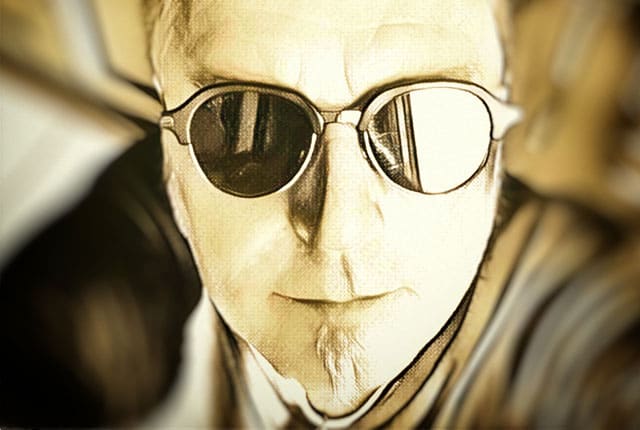
Barry Adamson occupies a uniquely embedded role within the film, appearing on screen as one of its witnesses while also composing the score that threads everything together. His connection to the Scala isn’t academic or secondhand. He was there, absorbing the atmosphere in real time, and that perspective shapes how the music functions. Rather than guiding emotion in the traditional cinematic sense, Adamson approaches the soundtrack as something more lived-in, a series of shifting presences that at times feel like different bands drifting in and out of the room, mirroring the cinema’s wildly eclectic programming.
Adamson’s involvement in SCALA!!! also feels like a natural extension of a career defined by movement between bands, scenes, and cinematic worlds. From his early years in Magazine to his time with Nick Cave & the Bad Seeds, and onward into a solo catalog that has consistently blurred the line between album and soundtrack, he has built a body of work rooted in atmosphere, storytelling, and instinct. Records like Moss Side Story established his reputation for creating vivid, filmic narratives without images, while decades of work across film, television, and collaborative projects have refined his ability to let music inhabit a space rather than dominate it. In that sense, SCALA!!! doesn’t mark a departure so much as a return, placing Adamson’s sensibilities back into a setting that helped shape them in the first place.
Over Zoom, Adamson discussed the approach and process behind creating the music for SCALA!!!, as well as his memories of experiencing the cinema firsthand.
You appear in the film in addition to having done the music. How did you get involved with the project initially?
Barry Adamson: Well, I’d known one of the directors, Jane Giles, on and off throughout the years, just from being around the scene, as it were. And I guess they just landed on my name as somebody who could take on the job of drawing all these elements together that you see in the movie from different worlds. And also, as you probably found out from watching the movie, I was there at the time, when a lot of these films were screened. So I had a kind of innate sense of the place and what was going on. I could smell the seats!
I know you were also working on your Cut to Black album at the same time. Did the two projects influence each other in any way, or how did you balance working on them simultaneously?
Barry Adamson: Well, I’m very much used to being like the working man and just getting up and going, “Okay, this is for this and this is for that.” So they were feeding me different things — different appetites, really — because they’re kind of different works. I mean, I have a few signatures, I guess, that I always put into the work, but I felt that one was supporting the other.
It was quite strange because I didn’t have to think about words. I was thinking in a totally different way about the themes and what was coming up. And in fact, the SCALA!!! score had me chasing it down the street. A lot of stuff was coming at me really fast, whereas I tended to be a bit more succinct with the ideas for Cut to Black. So they both provided… maybe I just used different brain parts or something.
What were your goals with the soundtrack? What did you feel the imagery needed as a complement musically? Going in, did you have a sense of what was needed or what your approach might be?
Barry Adamson: Before I saw anything, to be honest, I thought I was going to provide something way more avant-garde and suspenseful and strange — more at that end of the spectrum. Because that’s how I remembered the atmosphere being there.
But then, as I got more into the film, particularly watching it, there were other elements — like a sense of fun, and a joy in the fact that this even happened as a movement. So I kind of plugged into those things. I thought about if I were able to be in all these different bands, how would they sound putting music to the film? And that’s what I was able to do.
It came together very differently from those abstract, strange ideas. I mean, some of those ideas stayed — for particular scenes, like where the film is burning and that kind of stuff — but I wanted more of a… almost like placing it in the background, so that you could feel like, while watching the film, there was this band just chugging away from a different side of where you were sitting.
Are there any ways you could compare this to past soundtrack or instrumental work you’ve done?
Barry Adamson: Not really, because it’s strangely song-based in a way. It feels like instrumentals played by different bands. You have a ’50s combo doing a kind of mambo thing, then a ’60s rock thing.
In most films, you’re composing for drama — to guide emotion, to mislead, to support. But this was more head-on. I wasn’t signposting. I was more interested in what was happening underneath. I could always rely on bringing in one of the bands, as it were. That’s how my mind saw it, rather than thinking like “the composer.”
To what degree were you influenced by your own personal experience? Did you ever feel the need to step back and reassess after seeing the film or the interviews?
Barry Adamson: No, I felt I was in a privileged position of being plugged in. It was like I was sitting in the cinema, watching these interviews, and I could remember it all very clearly.
Sometimes I’d glean an idea from the way someone was speaking or telling a story. I remember thinking about the guy from Withnail and I, talking about the drugs — where they got them — and I was listening to his cadences and the way he told the story. I was listening through music. I was creating this little drama, but it also sounded like this electronic world.
That’s not something I’d normally do for myself, but I was applying the craft of composition to help set the scene while letting the listener absorb the story being told.
I really felt like I was in a privileged position, sitting there in my own cinema, with all these instruments around me, watching interviews and conversations and scoring them in a way that felt right.
When you saw the final film for the first time, were there any moments that surprised you in terms of how the music worked within it?
Barry Adamson: I think it elevated itself beyond my initial impression. I was focused on the work being the work, but when I saw it with other people, I could feel how I’d injected something that allowed it to breathe in a certain way.
Very little was changed. And that surprised me. I’ve learned over the years — I used to have the music way too loud, and then I’d see the film and think, “Oh, where’s it gone?” Now I tuck it in so it works with everything else but still has impact. That just comes with experience.
I was surprised how much they used, actually. Usually, things get cut. But they were very enthusiastic collaborators — very generous. They’d say, “Yeah, what do you think there? Go for it.”
They had this great idea early on. I had a theme that played at the end, and they said they thought the opening could use that theme too, but in another form — more like a Ventures-style groove. I hadn’t seen that yet, but I went with it. It was a challenge, but it worked beautifully.
Could you talk about how the soundtrack became an album? Does it include material that didn’t appear in the film?
Barry Adamson: Yeah, the album is essentially the music without the film. It runs from beginning to end in terms of the cues. Then I added a couple of outtakes — things that weren’t in the film at all. Some are very short. It’s like those ’60s soundtracks where you think, “Oh, that track — I’m in track 18 already.”
I think there are 22 tracks total. I probably recorded 40 or 48 pieces originally, and some were rejected or reshaped into other things. A couple of outtakes still feel like part of the film, but I changed my mind about using them as cues.
It circles back to Moss Side Story, which was a soundtrack without a film. This is sort of the same — a soundtrack with a film attached if you want to see it. And it runs in sequence, which I like, because the pacing of the film is really strong.
In terms of working with different styles, how do you balance representing something faithfully while still bringing your own voice?
Barry Adamson: I think experience gives you that confidence. You start to trust that where you’re going will work. I felt very confident bringing in these different styles, and I felt my experience really mattered — having been in different bands, worked in different kinds of music, worked with different artists.
The ideas came thick and fast. I was chasing them down the street, wrestling them to the ground — “Come on, you!” — grabbing a bass, then a guitar, then drums. It was just fun.
A lot of the time, you’re thinking, “Is this going to land?” But I like having someone else in the room — even just one person — to feel the reaction. That energy helped shape things. It didn’t feel like hard work. I wanted the joy to come through, not just the abstract or conceptual side.
Looking at the film now, do you see anything comparable today — spaces or scenes that reflect what was happening then?
Barry Adamson: I think there are small indie places around the country that have nights like that, influenced by the same spirit. But we live in a different time. I can’t imagine that secret-society feeling anymore — whispering, “They’re playing The Tin Drum at the Scala — get down there.”
But in another way, social media makes that kind of thing possible again. I’ve noticed in Australia especially that old cinemas are being revived for special screenings. There’s something interesting there. And with the idea that the analog world is coming back, maybe people will be listening to the soundtrack on cassette and heading out somewhere to experience it.
Right now, though, it’s hard — people are trained to consume media in a very specific way.
Watching the film now, do your memories ever differ from what’s presented?
Barry Adamson: I think people in the film are very eloquent, and their memories are spot-on. I was going through a kind of late, troubled teenage phase and don’t remember everything clearly.
What really struck me was the story I tell about The Man with the Golden Arm. I don’t think many people experienced it the way I did, and that moment really kickstarted things for me. I think the directors picked up on that.
I was in awe of how vivid everyone else’s memories were — how religiously they attended. I did see The Man with the Golden Arm a few times, and it really made me sit up and think, “Right, this is where you’re going.”
I don’t know if my experience was different, but it’s fascinating how many people went on to become creatives. It’s almost like a strange alternate university.
SCALA!!! Is out on January 16, 2026 via Mute on limited edition vinyl, CD and digitally. It can be pre-ordered here.
For more info on Barry Adamson, visit barryadamson.com.
Be sure to also check out our 2016 interview with Barry where he talks about his Know Where To Run album, Nick Cave and the Bad Seeds, Magazine and more.