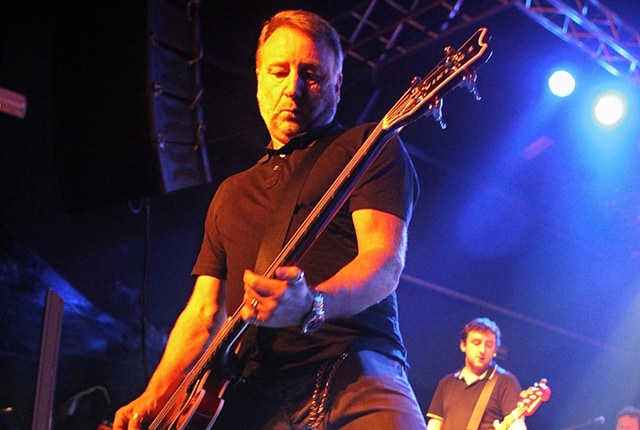
I first became aware of Gail Ann Dorsey when she was bassist and backup vocalist for Gang of Four on their 1991 Mall reunion album and tour. I was lucky enough to see them as part of the infamous “The Tune In, Turn On, Burn Out” tour, co-headlined by Sisters of Mercy and Public Enemy, as well as at an outstanding show of their own at Providence’s Club Babyhead. Dorsey brought an energy and freshness to the band that helped make up for the fact that Jon King and Andy Gill were the only returning members at the time.
Shortly after, while browsing a used record store in Boston, I stumbled upon and bought her solo album The Corporate World, which I had no idea existed. I was already a fan when I went to see David Bowie on his Outside tour and saw that she had joined his band.
Dorsey went on to work with Bowie through the rest of his career and also performed with artists such as Jane Siberry, Tears for Fears, Lenny Kravitz, and Matthieu Chedid. I’ve previously done two extensive interviews with her for Please Kill Me, but felt it was time to follow up on her current work. She released a single, “(It Takes All Kinds) To Make A World,” last year (on Righteous Babe Records) and is finishing her long-awaited new solo album. She performed with Thomas Dolby on the US leg of his “Iconic 80s Recollections Tour,” playing as part of his band and opening the shows with a solo set.
The following interview was conducted over Zoom on January 30, 2026. UPDATE 5/24/26: With her latest tour with Thomas Dolby completed, Gail Ann Dorsey has announced summer solo tour dates. See the full list here
Last time we talked, you were working on new music and hoped to release it soon. Could you talk a little bit about how you came to release the new music now, at this point in time?
Gail Ann Dorsey: Well, I was always kind of busy working with other projects. I think when we spoke, I was still with Lenny Kravitz, and I had various other things going on. I’d never really had enough time to focus on me and what it means to be a solo artist now. It’s been a long time since I did my last album, which was an independent release. There were platforms where people could download a song digitally, but streaming wasn’t a big thing, like the main thing it is now. And of course, when I did my earlier albums, they were with record labels, which was a whole other kind of landscape and mechanism that doesn’t really work the same way anymore.
So it took time. I had some songs ready. I didn’t have a whole album yet, and I’m still working on a few more songs to finish this one and get it ready for a summer release. But I had some songs I’d been working on, and I just never could really take the time, or make the time, to say, “Okay, I’ve got to focus on what it means to get these songs mastered, to get them mixed, to get them out into the world.” I just didn’t take the time.
But after the pandemic, there was a period when I wasn’t touring so much. I had a very big tour planned with Lenny Kravitz that was going to start in 2020, and of course everything came to a halt. So when he was going to start up again, I made a conscious decision during that time… well, I was working in France for a while, but there was a bit of downtime to think, “What do I do? How do I go forward from here?” Because I was planning to do the tour with Lenny and then call it quits with him anyway. So I thought, “Okay, I’m not going to return after the pandemic. I’m going to take this time to finally concentrate on what it means for me to be a solo artist again. Do I want to do it? Can I do it? How does it work?” And I’m still at the point now where I’m figuring that out.
It’s time-consuming. It’s challenging. I really don’t recognize the business.
But labels had their good side and their bad side. The good side was that there was more support. There was money available to help launch things. There was distribution and different departments that took care of things so you could just really do the music. And there wasn’t social media either, which is a whole other thing that I’m still figuring out. It’s time-consuming, it’s challenging, but it’s part of what has to be done.
So after I finished a job I had in Paris, I came back and decided, “Okay, this is it.” Now I have to figure out what to do, how to do it, how to still keep the lights on, how to keep working, but not take on any more large tours that take up to six months or more. Lenny was a full-time job—that was something I was doing for pretty much ten years. Every month there was something, so I was always at his beck and call.
So the last couple of years have really just been about setting up the foundation to finally launch myself as a solo artist again. Not to completely disappear from the session world or never work with anybody again, but to dedicate the time, because it was going to take time. It wasn’t something I could just throw in and do on the side. Maybe other people could, but for me, I need a period of time to really focus on one thing and do it well—or at least do it to my liking.
From a musical and conceptual standpoint, how has this material evolved from when you decided to focus on solo work again to where you are now, getting ready for the album?
Gail Ann Dorsey: Well, I think I’ve stayed pretty steady. Basically, I really wanted to honor the part of me that maybe a lot of people don’t realize, because of my work as a session player or my collaborations with other artists. They might not know the kind of music that I love or want to do.
I was very heavily influenced by the singer-songwriters of the ’70s—Carole King, Carly Simon, The Carpenters even, The Fifth Dimension. The pop music from that era made a very strong impression on me. I was born in 1962, and by the time I was five or six, and getting into the late ’60s and early ’70s, AM radio was a huge thing in my household. That was really the beginning of me thinking, “Oh, what’s this music? Why do I love this so much? What draws me to this kind of music?”
But then as I got older… I’m the youngest of five kids, and my older siblings all had really cool records—a great mixture of stuff from R&B to rock. There were Cream records, Stevie Wonder, Hendrix, Chicago Transit Authority—just all this amazing music. And then as I got into my teens, I was interested in everything. You’re trying to develop who you are, and you become more self-conscious about identity and all that. So in order to be cool, there were things I felt like, “Oh, I can’t say that I really love Karen Carpenter,” because the cool thing at the time was Earth, Wind & Fire.
Especially Olivia Newton-John as well. I just love Helen Reddy. I love this kind of music, and I also love the way the songs were crafted around these artists. I love the orchestration and the use of what’s available to you to create. I feel like now, basically, I’m honoring that part of me. That music was so rich to me. There’s a lot of music that I’m enjoying now—new music I’m discovering—but I find that most of the big pop songs, everything seems so one-dimensional and flat in some way. There’s no depth to the music in some cases.
You listen to a track from John Denver and there are all these colors, this beautifulness—or Bread, or America. The way songs were written and produced in those days was just luscious. And I can’t afford that now—that’s the sad thing. Those records were made with orchestras, endless budgets, vocalists, all of that. So I’m doing my best to honor that aesthetic of songwriting, of melody, and to make my songs and the presentation of the music as interesting, colorful, and rich as possible.
That’s what I was doing then with the songs I’d written, and that’s where I’m still headed—trying to make this a cohesive album. The other thing is that I was definitely gearing up to work on an album that’s somewhat of a theme album. My very first album, The Corporate World, was written intentionally around the climate of the time—money, Wall Street, the man in the suit, that whole ’80s vibe, the parties, the fractured relationships, everybody’s on coke—that whole thing.
So this is kind of part two in a way, but it’s more of a record where the songs are coming from a personal place, as well as observations of humanity—how we are today. It’s kind of asking: what is the result of the corporate world from when I put that record out to now? What has it done to us?
There’s more to it—there are songs about teenage suicide, for example, young people who just don’t make it. The album is called The Appearance of Life, and that’s really the theme: is this really life? How much of real life are we actually missing, especially now with everything being so virtual?
We’re moving toward anything other than what is real life. We’re looking to technology, to space, to all these different places that are really illusions. And I feel like we’re not really living the blessed life we were given—off the grid, or… I don’t feel like I’m reaching the place that is so obviously there, because there are so many things pulling me—and the world—in different directions. And in that, we lose sight of the basic beauty that we’re actually blessed with.

You previously talked about learning more about Logic and engineering so that you could take more control over your recordings. Could you talk a bit about how that process went?
Gail Ann Dorsey: When the pandemic came, it was the perfect time. I was home. A few years prior to that, I had been taking these online courses at Berklee College of Music. They do these 12-week courses in all different types of musical things, from bass to flute to producing, to whatever. And I had been taking guitar courses because I have no formal music training. Every now and then I like to try and learn something about what I’m doing, technically.
But there was a course offered for Logic. I used to take the other courses when I was out on tour with Lenny or on a job, because you have that downtime and it’s perfect—you practice, you take your guitar. But to do Logic, I needed a keyboard, and I needed to really concentrate. So when I had that 12 weeks of everyone being on lockdown, I did the Logic course, and it was really helpful. It allowed me to navigate, to know how to mix something, to add different effects and things like that, learning about buses—a lot of things I didn’t really technically know.
I had worked with tape machines and mixing desks forever, and I was quite comfortable with that. But when you put it inside a screen and it’s all these different… I don’t know, it was just hard to relate. It still is in some ways, but at least now I can really make my way around Logic quite well.
A lot of my album—I’ve gone into studios and done things that need drums, and things I needed to do with someone in another place. But mostly at home, I’ve been doing all the vocals, recorded in my home studio, and any little extra bits that I can manage to play. But there are so many people—for example, a local guitar player was recommended to do a part for me. So I go over to his house, take my hard drive, he pulls up Logic and drops in his parts, we do it, and then I bring it back home. So it’s this interesting kind of collaboration on the digital workstation. I’m pretty comfortable on Logic now.
They keep changing things as you go, though. Suddenly it’s like, “Oh, what’s this new thing?” or “Why is that popping up?” or “Why doesn’t that work anymore?” So they like to keep us on our toes, I guess—or maybe they just want more money. But yeah, it’s a comfortable thing for me now. I’ve also done quite a few online sessions for people who want a bass track, or sometimes a vocal track as well. So I’m able to do that from my home studio.
Do you feel it impacts your general songwriting process?
Gail Ann Dorsey: Not for me in particular. The only thing I find with the digital side is that now I’m thinking more like, “Okay, I’m going to do this and this is going to be it.” Whereas before, I would write a song, even if it was on an eight-track or a four-track or cassette, or just something strummed out on the guitar. And then I’d think about who was going to play on it. I’d book a studio date and go build the song with other musicians, which is really the best way to do it, especially the way those songs were made in the ’70s, that’s for sure.
But what’s difficult now is having the resources to do that kind of thing. So I find myself working in Logic in my home studio while I’m creating a song, and thinking, “This is going to be the song that goes out into the world.” This isn’t a demo, put it that way.
And I find that takes more time and a different kind of headspace, and I don’t really like that. It slows me down a little bit because I’m already looking for something that’s going to work. Even though you can change things digitally—move things around, edit them—I don’t like to work that way. I’d still like to use Logic like a tape machine, where I’m not moving and cutting and pasting.
Maybe that kind of editing is part of figuring things out, but then I want to do it as if you’re playing it; like you have to roll the tape and get it right, get a vibe going. So I think I get a bit more fussy with the digital process when it comes to songwriting.
I’m trying to make myself step away from the computer when I’m creating music, because that’s how it used to be. It would literally be a cassette recorder—the little ones you’d talk into—a guitar, maybe a drum machine going through an amp, just working out an idea. Then that idea would be brought to life with other musicians in the studio, like in the ’70s.
Now it feels more calculated in a way, and I try to get away from that. I find myself thinking more about details because I’m working in this digital environment where I have all these options and keep trying different things. So I’m trying to pull back from that, because I’d prefer to leave some space for when other musicians come in and add their parts.
Could you talk about working with other musicians on the album? Were there people you wanted to work with going into it, or was it more a matter of having songs and feeling they needed particular parts?
Gail Ann Dorsey: Well, so far it’s been a little bit of both of those things. There are so many incredible musicians here in upstate New York where I live—I mean, some of the most famous ones in the world. And most of them I know at this point, because I’ve lived up here for like 30 years now, longer than I’ve lived anywhere else. It’s quite a tight community of musicians and artists in the Hudson Valley.
So I’ve always loved Jerry Marotta as a drummer. I met him years ago when he was working with the Indigo Girls, with my best friend Sarah Lee, who is also a bass player who lives up here. So Jerry, so far, has been the only drummer, but I definitely want to work with some of my Bowie alumni. I’d love to get Sterling [Campbell] on a song.
On the single I released in October, there’s a guitar player who I didn’t know personally—I knew his work very well because I was completely crazy about the records he played on, especially a lot of the Paul Williams records. Paul Williams is one of my favorite songwriters of all time—he wrote “Rainbow Connection,” “You and Me Against the World,” “We’ve Only Just Begun,” and just countless others. That kind of songwriting really means a lot to me.
His guitarist on a lot of those early albums was David Spinoza. He was a session player who also worked with Roberta Flack, Donny Hathaway—so much music that I absolutely love. And oddly enough, he also played on albums by The Alessi Brothers, a band I loved. Those early ’70s records are some of my favorites ever. When I first started thinking about doing a solo project again, I even thought, “I wonder if those guys are around—I’d love to work with them,” because their records sounded so amazing.
Anyway, David Spinoza is the guitarist on my single “(It Takes All Kinds) to Make a World,” which I put out this past October. I met him years ago at a Beatles night at the Bearsville Theater—just a local show with a bunch of great players. I was singing a couple of Beatles songs, and David was the guitarist. I was like, “Oh my God, that’s David Spinoza…” It kind of freaked me out. He lives in Connecticut, so he’s not exactly local, but not far away either.
He’s also played with McCartney—he’s on Ram, I think—and he played that quirky little guitar solo on Dr. John’s “Right Place, Wrong Time.” That’s him. There’s a great story behind that, actually—he was in another session down the hall, stepped out for coffee, and they pulled him in to play that solo. He didn’t even know the chords, so he just sort of felt his way through it on the first take. That’s why it sounds so unusual. And they were like, “That’s perfect.”
So yeah, he’s one of my heroes. He’s on two songs so far, and I’d love to have him back for more when I finish a few additional tracks.
I’d also love to work with Tony Levin, who is actually my neighbor, to play some bass. I don’t have to play bass all the time. I’ve been doing some guitar on the record. I’ll definitely need a piano player, because that’s not what I play. And interestingly, a lot of the music I’ve written for this record is based around piano. In the past, I wrote more from guitar or bass, but something about this era of music; it just feels like piano to me.
That’s where Logic comes in handy. I can piece together the song on the computer and work it out. I can’t sit down and play piano from beginning to end, but I can hear it well enough to structure chords and melodies. Then I give it to a real pianist to bring it to life properly, with feeling, the way it should be played, and on a real piano.
I’ve tried doing sessions where someone sends me a piano track using software, and I just can’t use it. You can’t do Carole King with a sample—you just can’t. You need a real piano in a room to get that feeling. So that’s definitely a rule on this record: no piano software.
You’re opening these Thomas Dolby shows with a solo set, and I was curious what kind of instrumentation you’re using when you perform your music live currently. Do you work with additional musicians, or what is your presentation like?
Gail Ann Dorsey: It’s just me on my own with an acoustic guitar and a bass. I usually open the show playing bass and singing. I do a couple of songs just with bass and vocals, and I throw in a couple of cover songs. I’m no Gerry Leonard, but I’ve got myself a looper pedal.
I may pre-make some atmospheric loops on the pedal. So there’s a looper on my pedalboard, but I don’t build them on the fly during the show. A lot of times I’ll start with something already going on the loop, then add the bass and sing. I do two or three songs on bass, then I put the bass down and pick up the acoustic guitar, which also runs through a pedalboard. I’ll use some delay or maybe a bit of chorus to give it some vibe instead of just straight, strummed acoustic. And that’s it. It’s just me, my voice, and those two instruments.
I can’t really afford a band at this point, but when the record is finished, I’m going to find a way. I’d love to do some record release shows here in Woodstock. WDST, the radio station that’s been playing my single a lot, God bless them, they have a great new studio space where you can set up and do a live radio performance, almost like an album launch. They’ve had a lot of artists come through and do that.
I’ve also done a couple of local shows where Jerry [Marotta] is around, or someone else, and we get together and I can have a band, which is really fun. But taking a band out on the road, especially as an opening act; you’re not making much money, so it’s just not practical right now.
So it’s good practice for me. It can be a little lonely, but it’s fun. I get to talk to the audience and take my time, since it’s just me up there. There’s nothing to hide behind, but it’s been going well. And I’ll be doing the same thing for Thomas. I go out, do my set solo, then I go back, change my clothes, and come back out with him.
I know you performed with Thomas Dolby years ago during the Bowie era. How did you come to tour with him now?
Gail Ann Dorsey: He called me. I had no idea what he was doing. I hadn’t heard from him or really thought about him in years. Then last year, he called me out of the blue and said he was working on this project called Iconic ’80s. He had written part of, and is continuing to complete, a symphony in five movements—like a traditional symphony—based on iconic ’80s songs. Some of the most well-known and influential ones, the kind we all immediately recognize. It really highlights how incredible some of those songs were.
When you think back to the ’80s, it was a very different sonic landscape, but songwriting was still at its peak. It was stellar. I think it started getting weaker after that, and now it’s really weak in some ways—nothing really sticks. There’s nothing to hold onto, no depth. It just feels kind of flat. But anyway, I digress.
So Thomas had written two movements already. It’s essentially an orchestral piece—he wants to perform it with a full symphony—but it’s blended with his own style and approach. He’s taken these snippets, almost like a medley, of ’80s songs—from his own work into Michael Jackson, Talking Heads, U2, Duran Duran, Grace Jones, Eurythmics, Prefab Sprout—and woven them together. Alongside that is a full symphonic arrangement with string parts and everything.
Right now, it’s computer-based. Thomas plays keyboards and triggers samples—he’s like a mad scientist over there, which is what he does best. He’s a genius at that. I’m playing bass—both live bass and bass synth on certain parts—and there’s a guitar player handling all the different tones, dialing in everything from Edge-style sounds to funk parts for the Michael Jackson sections.
Everything else, the orchestral parts, is coming from the computer. The movements are about 20 minutes long. Thomas also narrates throughout, telling the story of his life and career—how things evolved, what he experienced, and how music changed. It’s almost like a musical history piece. And he’s actually a professor now, which I didn’t know until he called me.
I asked him, “Where are you?” and he said, “I’m living in Baltimore.” I was like, “Baltimore? What are you doing there?” But he’s a professor at the Peabody Institute at Johns Hopkins University, which is a very well-known music school. He teaches film music and game music—programming, all of that stuff, which he’s brilliant at.
He told me that after teaching, he’d go sit in on orchestral rehearsals—just listening to students playing Beethoven or whatever they were working on—and that’s what inspired this project. The power of an orchestra, the emotion, all those musicians connecting together—it’s incredible. That’s what led him to create this symphony.
What we’re doing now is kind of a test run—figuring out how this concept works live, blending musicians with the symphonic elements. This time we’re adding a drummer [Mat Hector, best known for Iggy Pop the last 6-7 years, also KT Tunstall, Soft Cell and Thom Yorke] , which we didn’t have before. Previously it was just Andrew Lipke, the guitarist, and myself playing along with tracks. The computer was really running the show, and we were fitting into it.
To be honest, that wasn’t that enjoyable for me. When you hit the space bar and the track starts, you’re locked in—you’re following it, it’s not responding to you. You can’t really breathe with it the way you do with other musicians. When you’re playing together, even subconsciously, you’re listening and adjusting, and the music moves. With a computer, you don’t have that flexibility—you have to hold on tight.
So adding a drummer this time should help make it feel more natural, hopefully more comfortable. And eventually, the goal is to do it with a full symphony orchestra.
That’s really the whole concept. Right now, we’re kind of building it, testing it, and getting interest. I know he’s been making videos and trying to move it toward a full orchestral production. The programming we used before was incredible; you almost wouldn’t know it wasn’t a real orchestra unless you were really listening closely. A lot of film scoring is done that way now. But still, having the real thing would take it to another level.
So this time, we’re going out with new material, new movements. We perform different segments where I might sing something from Eurythmics, Annie Lennox, or Grace Jones. We share the vocal parts and Thomas does narration between sections.
We’ve done things like “Here Comes the Rain Again,” “Ordinary World,” which is one of my favorite songs ever, and there are visuals and projections as well. It’s a really interesting show.
Since this does seem to be an ongoing project, was there any hesitation about getting involved again, given that you also want to focus on your solo work?
Gail Ann Dorsey: Well, it’s not a long commitment, but there is some prep work involved. And honestly, I was really, really on the fence about coming back to do it again. When he first mentioned it, I thought, “Oh, it’s only nine shows. It’ll be maybe a week of rehearsals beforehand.” That I can handle. Six months away, I can’t handle anymore. Three months away, I can’t handle it. And I did 10 dates with Joan Osborne last year as well, so I know I can do a couple of weeks. I still have to work sometimes, but I’m not taking on a big project that’s going to take months, or a whole year, out of my life again.
So I was hesitant to return, because the first time I got a little blindsided. He told me about the project and I thought, “Oh, that sounds really cool.” But then all of a sudden he’s sending me files—asking me to play bass parts so he can hear what it’ll sound like, then asking me to sing parts and send them back. Then, “Oh no, can you change that? That note’s not right…” And suddenly I was spending a whole day at home in my studio working on his pre-production.
At one point I had to say, “Wait a minute, this isn’t like a normal gig.” I thought it was going to be you send me the music, I learn my part, I show up to rehearsal, we rehearse, and then we do the show. But recording, mixing tracks, going back and forth, that wasn’t what I had anticipated. So I was a bit like, “Hmm, this is a lot more work than I usually do.”
So myself and the guitarist had to kind of school him a little bit, ike, “Hang on, this is more than just a standard ‘here’s my part, I learn it, and I show up’ situation.” With that in mind, going into this next run, I knew what to expect. I’m going to carve out specific time to focus on his material, because before he was sending things and I couldn’t always get to them—I was working on my own stuff or doing something else. And I had to say, “You’ve got to wait a minute.” He’s very eager to keep things moving.
For more info, visit gailanndorsey.com.