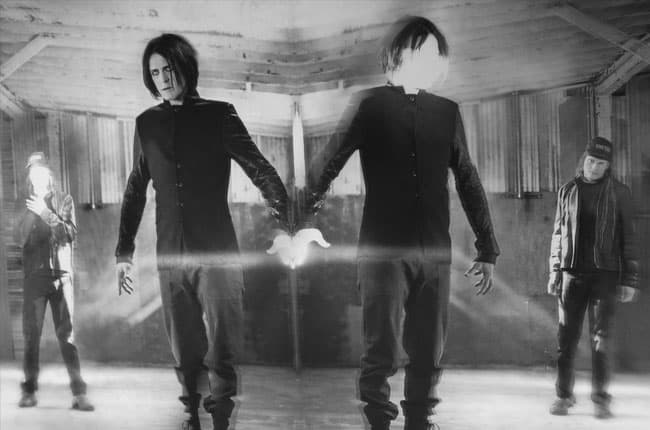
Justin Warfield’s first full solo project since co-founding She Wants Revenge, WARFIELD is shaped by the early Los Angeles deathrock scene and its collision of punk, art rock, and DIY culture. Rather than treating that era as nostalgia, the project draws from a specific time and place when scenes overlapped freely and creative identities were still being formed. What began as a handful of darker, faster songs quickly took on a life of its own.
WARFIELD’s music builds on Warfield’s long-standing relationship with rhythm, repetition, and the dancefloor. Deathrock Devotionals, WARFIELD’s debut album, weaves electronic pulse and live instrumentation into throbbing basslines, driving drum patterns, and guitars treated as texture as much as melody. While the songs carry punk urgency, they are written with live performance in mind, leaving space for tempo, tension, and momentum to shift organically from night to night.
For Warfield, WARFIELD emerged less from a decision to make a solo record than from a process taking shape. As the songs accumulated, it became clear this wasn’t just a collection of tracks, but the beginning of a band. Unlike earlier side projects that deliberately moved away from the She Wants Revenge universe, this material remained close, separated by intent rather than opposition, allowing him to explore new intensity while staying connected to the rhythmic and atmospheric instincts that have always driven his work.
That sense of identity sharpened once WARFIELD moved from the studio to the stage. Built to be played live rather than locked to tracks, the songs open up in performance, where tempo, tension, and interaction shape each set differently. Alongside longtime collaborator Thomas Froggatt, drummer Delano Duran, and guitarist Spencer Rollins, Warfield treats the live setting as a space of responsiveness, where the music is shaped in real time by the band, the room, and the audience.
Having performed in Europe last year, plans are underway to tour North America. This Zoom Q&A explores how the project took shape, the scenes and processes that informed it, and how WARFIELD continues to evolve once the songs enter a live setting.
What led you to do a project under your own name at this point in time?
Justin Warfield: That’s a great question. Hold on a second. I am on the wrong Wi-Fi network. Stand by. Let me switch us over.
She Wants Revenge was not recording music at the time. I had done a side project under the name Forever Never Changes, which was really a moment in time that happened around 2020, during the pandemic. But I felt like it was time to move on from that because the world was changing. I felt like I had different things to express. The sound and feeling that I was expressing in those songs was no longer with me. I was in a new place. I was feeling excited about music.
Sometimes I work on music and write music — I don’t work on music and write songs as a catharsis or a way of therapy or journaling. I’m not that type of writer. I don’t just pick up a guitar or a pen and say, “This is what I’m feeling. I need to get it out.” I’m the type of writer, I suppose, who loves the process. And through the process, things happen.
So I might sit down to play guitar because I see one of the many guitars that I’ve picked up at different points in my life, and I go, “Oh, I haven’t picked up that guitar in a long time.” And I pick it up and start playing. I have no idea why that guitar called out to me out of the several guitars. I pick it up and immediately I start playing some riff or figure that feels a certain way, and I’m like, “This is cool.” Maybe I record a voice note on my phone. Maybe I sit down and record a whole song. I don’t know why I sat down to grab that guitar. I’m certain that if I’d grabbed another guitar, that song wouldn’t have come out.
And so I find purpose and meaning through process, I think, is what I’m saying. So I didn’t say, “I need to make a solo record.” I wrote a series of songs that felt different than other solo stuff I’d done before because it was darker, it was faster, it was harder. And a lot of times when I start a music project, I like to set rules or limitations. It’s something that I heard verbalized by Trent Reznor and Atticus Ross once — because they have everything at their disposal with their abilities and technology, in order to really find creativity… and I don’t want to put words in their mouths, but they set rules. Whether it be, “Okay, for this record, we’re only going to use monophonic synthesizers,” or “We’re not going to use this tool,” or “We’re only going to use these tools.”
When you create parameters and boundaries, you set up what you can do, as far as play goes. And I don’t mean music playing — I mean play, having fun. So once you have rules and parameters, you know what you can do.
For myself, I started writing these songs. They felt darker, edgier, and they really had a punk spirit, which is not something I’ve ever really had in any music I’ve done, except perhaps that sort of Detroit Stooges / MC5 proto-punk energy in a band I was in at the turn of the millennium called Tape.
But all that to say, I started writing these songs and they had an energy. And that coalesced at the same time that I was reading a book about Los Angeles death rock by an author, Mikey Bean. I had met a DJ at a spiritualist witch store where I was buying some candles, and he started talking to me about death rock and turned me on to a new band from Chile.
I was also working on a film project that took place in 1985 in Los Angeles. And I’d been talking to some friends who lived through the end of the second wave of L.A. punk. We were talking about that scene, particularly Ron Athey and Roz Williams from Christian Death. And this person — rest in peace — my friend John Albert, who died two years ago. The reason the album is dedicated to him is because he never got to hear this, and it was definitely inspired by him. Christian Death was founded in his basement. It was just him and Roz at first, when they were kids.
So all of these things converged at the same time. The long-winded way of saying it is that when I put up a drum machine and turned it up maybe 40 beats per minute faster than I ever had before, and I started playing a guitar part and slid up the neck in a way that felt like Rick Agnew from the Blue Adolescence record or “Romeo’s Distress,” and I turned the modulation pedal on my vibrato up and it sounded unstable — all of a sudden I imagined people pogoing, and I felt like I was in the Batcave. And I went, “Oh, this is a fucking new band. This isn’t just a song.”
What were the first songs that you did?
Justin Warfield: “All the Fun (Kiss, Kiss, Kiss)” was the first.
So a song like “Get Away/Far Away” — that beat was originally under a very, very, very poppy, beautiful song. And when I say poppy, I mean poppy to me, which is like 1982. I don’t reference new pop. I think of a song like “True Faith” as one of the poppiest songs I’ve ever heard, but in a good way. I think of early Madonna — that kind of pop. Duran Duran, Soft Cell — those were the records that inspired me when I was a child and learning about songwriting.
So there was a song already over that beat. Then I had Thomas Froggatt — who plays bass in WARFIELD, and also in She Wants Revenge — come over. We’ve been playing together since 2001. He came over and I muted all the music. I just had a drum beat and I said, “Let’s just jam.” And we started playing, and “Get Away/Far Away” came about.
That was an early song, as was “All the Fun,” that really set the parameters for the band and the project. To me, it was like, “Okay, if this is going to be in the same musical universe as She Wants Revenge…” Because since I started She Wants Revenge with Adam Bravin at the end of 2003, all my side projects have been vastly different — intentionally. Whether that was making the Black Hesh Cult hip-hop mixtape in 2011, or doing a sort of California Laurel Canyon, harmony-laden, Fleetwood Mac / Neil Young / CSN project called Dream Club with my wife and best friends in 2016, or Forever Never Changes during the pandemic, which explored shoegaze and Britpop inclinations.
This was the first time something felt parallel to She Wants Revenge — even in the same universe. So to delineate that and keep some separation, I was like, “These are the pedals I don’t use in She Wants Revenge. These are the sounds I don’t use. These are the tempos. These are the energies.” And I found a new voice, both literally and figuratively.
It wasn’t intentional, but when I started playing guitar parts that were a certain way, Thomas said, “A lot of this sounds like The Damned.” And then I noticed some Cramps, some B-52s, and a lot of the stuff I might’ve once called spooky — stuff I was honestly kind of averse to before, because She Wants Revenge never leaned into the goth label.
We started as a band influenced by Giorgio Moroder, Tangerine Dream, Vangelis, Silver Apples, Suicide, New Order, The Smiths, The Cure, Depeche Mode, Prince, of course Bauhaus and Sisters of Mercy. But once I started writing songs that were really dark and really high-energy, it felt like I was connecting to a lineage — especially early L.A. death rock, when punk bands and art rockers got dark. It’s a different spirit.
So I started to see, “Okay, this is something separate.” And I’m still finding that separation. As we work on She Wants Revenge music, it’s very clear what feels like She Wants Revenge and what feels like WARFIELD.
I never intended to do something in the same universe, but I also didn’t feel like intentionally moving as far away as possible this time. For the first time in 20 years, the things I want to do all live in the same ballpark. I also make music videos. I also write films. I have film projects I’m developing. It’s all the same thing now. Whereas before, I wanted music to feel like this and film to feel like something else. Maybe that’s just getting older and having focus. Maybe it’s alignment.
The music definitely has its own identity. Was it obvious that you wanted to use your name for the project rather than coming up with something else?
Justin Warfield: Yeah. I mean, the Forever Never Changes project was originally called WARFIELD. And then someone said to me, “You shouldn’t use your name for this project.” And I kind of agreed.
So rather than have that project be called WARFIELD, the album itself was titled Forever Never Changes, and the artist was WARFIELD. It was never released. So when it came time to release it last year, I thought, “Instead of just calling the album Forever Never Changes, I’ll name the band Forever Never Changes.” It became something I could return to or not.
That was originally a band name I’d considered back in 2018, so that felt fortuitous. But as soon as I saved the name WARFIELD again, I knew — mainly because when I record hip-hop, I’ve always done so under Justin Warfield. I want to keep that name for when I do features, hip-hop, or composing work.
But I wanted something that felt like a project. And a couple of people suggested, “You should just call it WARFIELD.” At first I resisted — I didn’t want the focus to be on me. But then I started thinking about it and went, “It just makes sense.”
There were two EPs leading up to the album. At what point did it become clear what path you wanted to take with releasing the material?
Justin Warfield: Originally, my plan was to do three EPs, one full-length album, and then combine everything into a double album, along with a number of music videos.
When I partnered with Cleopatra, I pitched it that way and they were really enthusiastic. But as we went along, it became clear that a double album came with challenges — financially, and also just for kids being able to afford it. So I was like, “Okay, a single album sounds good.”
As I was recording, there were certain songs that didn’t feel as strong. So three EPs started to feel a little ambitious. And once I started touring and playing shows with WARFIELD, and making videos, it really cut into recording time. So I thought, “It can either be three EPs, or it can be two really strong EPs.” You cut the fat, add a song or two for the album, and then you have B-sides.
I think lean and mean is better. It reminds me of the albums I grew up loving — not 18-song records. That was always the intention.
Then after doing the first music video and assembling this cast of characters — these interesting kids — it became clear they were becoming a kind of repertory group, like filmmakers who use the same actors over and over. The inspiration for casting young people came from a friend who heard the early demos. He said, “I think this is the best project you’ve ever done. My only note is that I don’t think you should be in the videos,” suggesting that it should be someone younger.
At first I was like, “Yeah, a lot of middle-aged guys make themselves the focus, and it’s hard to relate to.” And honestly, I hate being in videos. So any excuse not to be the face of it was great.
So I cast a bunch of kids and young people. We filmed the video for “All the Fun” at my favorite Chinese restaurant in Los Angeles — Genghis Cohen, owned by friends of mine. Coincidentally, one of the biggest inspirations for the project was that moment in L.A. when Chinatown was the center of punk rock, with places like Madame Wong’s and the Hong Kong Café. There’s a great documentary called The Chinatown Punk Wars that you can stream.
We shot in the back of the restaurant, and I played the song for the kids. I told them, “I don’t want you to hear it again until we’re rolling. I want you to experience it on camera.” And as we filmed, I felt like I had my own Warhol superstars. Certain people were clearly going to be in every video.
A lot of things happened very last minute. And I think when you set things in motion with the right intentions — when they’re coming from a good place and aligned with something bigger than you — things just happen. We’ve made a bunch of videos that feel really special with a group of collaborators, and then when we went to Budapest, Hungary, Greece — all over the world — kids who had seen the videos were like, “We want to be in the next one.” And we did that. It’s been incredible and one of the most rewarding parts of the whole process.
Could you talk about the musical collaborators in WARFIELD?
Justin Warfield: Yeah. The closest collaborator is Thomas Froggatt, who I met in November of 2001. We’ve been playing together ever since. He was originally the guitar player in She Wants Revenge and now plays bass in both She Wants Revenge and WARFIELD. We’ve written many of the songs together.
Spencer Rollins is someone I’ve known a long time. He’s part of my filmmaking team — we make music videos and short films together. He plays guitar in the live lineup, not on the album, but he will be on the next one.
Mr. Pharmacist — Gregg Foreman — originally had a band called The Delta 72. He’s played with Cat Power, Lydia Lunch, and Alan Vega. He’s a deep musician and a really interesting guy. He helped start a Philly soul scene in the ’90s. The Delta 72 were huge — the Strokes and the White Stripes opened for them. He was also part of the Discord and Washington, D.C. punk scene, which I’m a huge fan of.
Then there’s Delano Duran, an amazing drummer and musician I met years ago at a show. He later came back into our lives when we were looking for a drummer, and he was perfect. He plays in Sacred Skin and a bunch of other L.A. bands — too many to name — and when he came in, everything clicked. That’s when it became clear what this was going to be live.
At what point do you start thinking about the live aspect?
Justin Warfield: I’m always thinking about it. As soon as I record something, I think about what it’ll be like live.
One of the biggest differences with this project is that I didn’t want to play to tracks. I didn’t want electronics onstage unless they were being manipulated live. I wanted tempo to be unstable — to speed up and slow down.
What’s been really fun is how much energy that creates. We can play a song like a ripping punk song. We can do covers — because early on we didn’t have a deep catalog. We were playing songs from the first EP, songs from the second EP, some She Wants Revenge songs, and covers.
Eventually, I started stripping away the She Wants Revenge songs because that band is active, and I’d rather play WARFIELD songs. So we started doing covers like “New Rose” by The Damned, “A Northern Soul” by The Verve, and “The Highway” by an L.A. band called Nymphs.
When we played the Verve song, it became this big, psychedelic, heavy thing — not distortion-heavy, but groove-heavy and soulful, almost spiritual, like the Verve or Jane’s Addiction. That kind of thing can’t happen with backing tracks.
Once Delano joined, it became clear it could be bigger and broader. That was exciting.
Are there particular songs that feel different live?
Justin Warfield: Yeah. “Get Away/Far Away” has always been interesting to me. Guitar-wise, it’s very simple and kind of feels like a ’90s grunge-era thing. It also feels very Joy Division to me, which makes sense — they’ve been a big influence for 20 years. Live, though, it becomes something else entirely. It builds and evolves.
Songs like “Jet Plane” and “All the Fun” are punk on record and even more unhinged live.
One that really evolved is “If the World Comes Crashing Down Tonight.” When I wrote it, I thought, “This is the most Johnny Marr thing I’ve ever played.” I almost wanted to message him and say, “This isn’t lifted from anything — it just came out.” I can’t play guitar like him on his worst day, but the feeling was there.
Vocally, I wanted to make sure it didn’t land anywhere too derivative. One day, driving through downtown L.A., I suddenly thought, “Oh my God, this is like Johnny Marr meets Jim Morrison.” It was wild.
Live, it evolved even more. There’s a part where the guitar breaks down, and one night a girl in the front row started singing along to the guitar part. I stopped the band and said, “Hold on — everyone be quiet.” I told her, “What you’re doing right now is amazing, and I’m going to take it. From now on, when people sing this part live, it’ll be because of you.” And that became a thing.
That’s the magic of live performance. You can’t plan that. If something special happens, you amplify it. If someone gets hurt, you stop the show. If something beautiful happens, you lean into it.
Purchase Deathrock Devotionals at https://cleopatrarecords.bandcamp.com/. For more info, visit justinwarfield.com.